
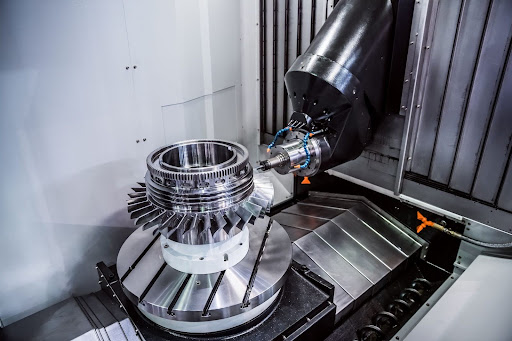
In order to meet the requirements of accuracy, efficiency, and flexibility of the parts, modern manufacturing relies heavily on 5-axis CNC machining services. Whereas traditional machining methods are restricted to working on a few planes, 5-axis machining lets the cutting tool move in various directions in a single setup. This way, manufacturers are able to make very detailed parts not just at a higher level of precision but also with consistent quality.
Such a technology has become vital to quality-conscious industries, which also need time-saving production methods. Knowing its operating principles, applications, and cost factors will provide the basis for the right manufacturing decision.
Understanding the Fundamentals of 5-Axis CNC Machining
5-axis CNC machining is a method of manufacturing where the cutting tool is allowed to move along five different axes at the same time. Apart from the usual linear movements of X, Y, and Z, two additional rotational axes permit the tool or the workpiece to tilt and rotate. Thus, by simply rotating the component, several sides can be machined without having to remove and reposition the workpiece again.
Consequently, this change of process results in the elimination of manual operations, thus allowing for greater accuracy. When a complex shape is cut in one single operation, the nearest results that can be obtained to the specification are the finishes which are finer and the tolerances which are tighter.
Why Manufacturers Prefer 5 Axis Machining
5-axis machining has been increasingly adopted by the manufacturing industry because it can effectively address the issues that conventional machining faces trouble with. Besides the ability to manufacture complex shapes, the other advantages are no less significant.
The main benefits that 5-axis technology brings to the table include:
- Higher accuracy: Fewer setups reduce alignment errors and cumulative tolerances.
- Improved surface finish: Continuous tool movement ensures smoother results.
- Reduced production time: Multiple sides are machined in one cycle.
- Design freedom: Complex contours and deep cavities become easier to manufacture.
- Lower tooling wear: Optimal tool angles help extend tool life.
Such benefits can make 5-axis machining an ideal option for parts requiring both precision and performance.
How 5 Axis Machining Improves Consistency and Repeatability
Another advantage of 5-axis CNC machining that is rarely discussed is its ability to produce uniform and repeatable parts across different production runs. When a single setup is used to machine several surfaces, the process limits manual handling and repositioning, which are the main causes of dimensional differences, to a great extent. Such a high degree of control is essential for those industries where the parts need to be identical and dependable.
Moreover, consistent tool orientation aids in keeping the cutting conditions stable, so there is less variation in the quality of the finished parts, fewer problems during the inspection, and easier transition from prototyping to mass production.
Applications Across High-Precision Industries
Industries that heavily depend on advanced engineering sometimes require parts that can hardly be produced by standard machining techniques. 5-axis machining facilitates such requirements by allowing the creation of complex shapes without compromising the precision.
Typical applications are:
- Aerospace structural and engine components
- Medical implants and surgical instruments
- Automotive performance and prototype parts
- Industrial tooling and moulds
- Energy and power generation components
In the production processes, 5-axis CNC machining services are sometimes a preferred solution over conventional CNC methods when the latter become insufficient, especially when dealing with complex geometries, undercuts, and very tight tolerances.
Materials Commonly Used in 5 Axis Machining
5-axis CNC machines can handle various materials. The selection of material mainly depends on the extent of the application’s requirements, the necessary strength of the component, and its working environment.
Commonly machined materials are:
- Aluminium alloys for lightweight strength
- Stainless steel for corrosion resistance
- Titanium for high-strength, to weight applications
- Engineering plastics for specialised industrial uses
- Tool steels for moulds and dies
Every material is associated with a set of cutting conditions that makes not only knowledge but also expertise and process planning necessary to ensure the quality of outcomes.
Cost Factors That Influence 5-Axis CNC Machining
5-axis machining does provide great benefits; however, the costs could be influenced by a few technical and operational factors. Knowing these factors will allow one to have proper expectations.
Primary cost considerations are:
- Part complexity: Detailed designs lead to longer programming and machining times.
- Material type: Hard or exotic materials raise tooling and cycle costs.
- Tolerance requirements: Tighter tolerances call for precision setups and inspections.
- Batch size: Prototyping and small runs usually have higher costs per unit.
- Machine time and tooling: High-tech equipment and specialised tools are part of the overheads.
Even though the upfront cost may be higher than that of standard machining, the isolation of rework, setups, and lead times usually results in a long-term gain.
Design Considerations for Better Machinability
The best way to take full advantage of 5-axis machining is through a design collaboration. Usually, engineers and machinists partner up to produce parts that are optimised for efficient production.
Some of the design habits that can facilitate production include:
- Avoiding unnecessary tight tolerances
- Designing smooth transitions instead of sharp internal corners
- Allowing sufficient tool access for deep features
- Selecting materials aligned with functional needs
All these factors contribute to a more straightforward production process, with no compromise in performance and quality.
How 5-Axis Machining Supports Innovation
The need for manufacturing processes that can keep up with innovations in product designs is becoming more and more evident. 5-axis machining is a great support for rapid prototyping, custom components, and low-volume production without compromising precision.
Its versatility allows for quicker design iterations, which is why it fits so well in those industries where performance and reliability are required to be at the highest level. This level of flexibility has turned 5-axis machining into one of the bases of today’s precision manufacturing.
A Thoughtful Way Forward for Precision Manufacturing
5-axis CNC machining services are a viable and visionary response to the need for complex, high-quality components in various industries. The process, through its capabilities of supporting advanced materials, intricate designs, and consistent accuracy, is well in tune with the future of precision engineering. The technology from CNC machining and precision engineering to aerospace components, medical device manufacturing, multi-axis machining, high-precision machining, and CNC milling services is instrumental in meeting the diverse requirements of modern manufacturing.
From our perspective, teaming up with experienced partners is the surest way to unlock a technology’s full potential. Among established manufacturers, Gemsons stands out as a reliable choice, known for its technical expertise, process discipline, and commitment to quality-driven machining solutions.