
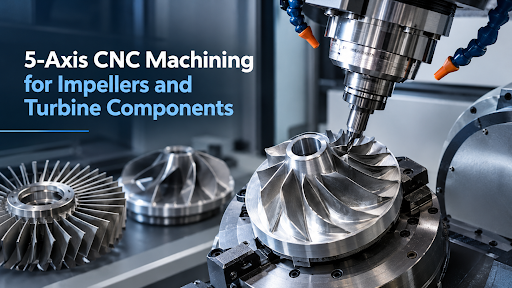
Impellers and turbine components are important parts of equipment used in power generation, aerospace, industrial machinery, and other engineering applications. Their complex shapes, curved surfaces, and precise dimensions make them challenging to manufacture. Even small variations in geometry can affect how these components fit and perform within an assembly.
Traditional machining methods may require several setups to reach different surfaces and angles. This can increase production time and create additional opportunities for alignment errors. 5-axis CNC machining services provide a practical solution for manufacturing complex components by allowing the cutting tool and workpiece to move along multiple axes. This approach supports the machining of intricate profiles while maintaining control over dimensional accuracy and surface quality.
Understanding how this process works can help manufacturers make informed decisions when producing precision-engineered impellers and turbine parts.
Understanding 5-Axis CNC Machining
5-axis machining combines movement along three linear axes, known as X, Y, and Z, with rotation around two additional axes. This gives the cutting tool access to multiple sides and angled surfaces of a component without requiring the workpiece to be repositioned manually for every operation.
This capability is especially useful when a component includes curved passages, angled features, or complex contours. The machining process can be programmed using computer-aided manufacturing (CAM) software, which helps define the tool paths required to produce the component from its design.
Depending on the component geometry and machining strategy, 5-axis technology can help manufacturers:
- Machine complex surfaces with greater tool access.
- Reduce the need for repeated workpiece repositioning.
- Maintain more consistent relationships between machined features.
- Improve access to difficult-to-reach areas.
- Support the production of custom components based on engineering drawings.
The actual results depend on the machine, cutting tools, material, programming, workholding, and inspection process.
Why Impellers Require Advanced Machining
Impellers commonly feature a central hub and multiple blades arranged around it. These blades may have curved profiles designed around the operating requirements of the equipment. Manufacturing them requires careful control over the blade shape, spacing, and surface geometry.
Machining becomes more challenging when the blade surfaces are curved or positioned at varying angles. The cutting tool must reach these surfaces while removing material without damaging adjacent features.
5-axis machining can help address these challenges by allowing the tool to approach the workpiece from different directions. This flexibility is valuable for producing complex blade profiles and reducing the number of separate setups required.
Key considerations when machining impellers include:
- Blade geometry: The shape and orientation of each blade must match the component design.
- Surface finish: Machined surfaces need to meet the requirements specified for the part.
- Dimensional accuracy: The hub, blades, and other features must remain within their specified tolerances.
- Material selection: Cutting parameters and tools must suit the material being machined.
- Inspection: Finished parts need to be checked against the relevant drawings and specifications.
These factors make process planning an important part of impeller manufacturing.
The Role of 5-Axis Machining in Turbine Components
Turbine components can include blades, vanes, housings, and other parts used in turbomachinery systems. Depending on the application, these components may have intricate profiles and tight dimensional requirements.
Turbine blades, in particular, can involve complex three-dimensional surfaces. Their geometry must be manufactured carefully to meet design requirements. A machining approach that provides access to multiple angles can help produce these shapes while limiting unnecessary repositioning.
5-axis machining may be suitable for components that require:
- Curved and angled surface machining.
- Multiple features positioned across different faces.
- Complex profiles that are difficult to reach using conventional setups.
- Close control over dimensional relationships.
- Custom machining based on detailed engineering drawings.
The process must still be matched to the part’s design, material, tolerances, and inspection requirements. 5-axis capability alone does not guarantee that every component will meet its specifications.
Key Benefits of 5-Axis Machining for Complex Components
5-axis machining offers several advantages when producing intricate engineering parts. The value of each advantage depends on the component’s design and the manufacturing requirements.
1. Greater Access to Complex Surfaces
The additional rotational axes allow cutting tools to reach surfaces that may be difficult to access with conventional 3-axis machining. This is particularly relevant for impellers and turbine components with curved blades, angled features, and complex contours.
2. Fewer Setups and Reduced Repositioning
Machining a component in several setups requires careful repositioning and alignment. Every additional setup introduces another opportunity for positioning errors. 5-axis machining can reduce these requirements when the component and machining strategy allow multiple features to be completed in one setup.
3. Improved Control Over Surface Finish
Tool orientation influences how a cutting tool interacts with the workpiece. 5-axis machining allows the tool to approach a surface from different angles, which can help maintain suitable cutting conditions and achieve the required finish.
The final surface quality still depends on tooling, cutting parameters, machine condition, and material properties.
4. Support for Complex Engineering Designs
Modern engineering components often feature geometries that are difficult to produce using conventional machining methods. 5-axis CNC machining services support the production of these designs by providing greater flexibility in tool movement and workpiece access.
This is useful when manufacturers need to produce custom components from detailed CAD models and engineering drawings.
Material and Process Planning for Impellers and Turbine Parts
The choice of material and machining strategy plays an important role in component manufacturing. Materials used in precision engineering can vary considerably in their machinability, strength, and response to cutting operations.
For example, stainless steel, alloy steel, aluminium, titanium, and other engineering materials may require different tooling and machining parameters. The appropriate choice depends on the component’s intended application and design specifications.
Before machining begins, manufacturers should consider the following factors.
- Material properties: Understand the material’s machinability and any specific processing requirements.
- Component geometry: Identify curved surfaces, deep features, and areas that require specialised tool access.
- Tool selection: Select cutting tools suitable for the material and required surface finish.
- Workholding: Ensure the component remains securely positioned during machining.
- Programming: Develop tool paths that account for the component geometry and potential tool interference.
- Quality inspection: Verify dimensions and surface requirements at the appropriate stages of production.
Effective planning helps manufacturers address potential machining difficulties before production begins.
Quality Control and Dimensional Accuracy
Impellers and turbine components must meet the dimensional requirements specified in their engineering drawings. Depending on the application, these requirements may cover blade profiles, diameters, feature positions, surface finishes, and the relationship between different machined surfaces.
Quality control should therefore be considered throughout the manufacturing process rather than only after machining is complete.
Important practices include:
- Reviewing technical drawings and tolerances before production.
- Checking raw material and component identification where required.
- Monitoring machining operations for dimensional variation.
- Inspecting critical features using suitable measuring equipment.
- Comparing finished components against approved specifications.
5-axis machining can reduce the need for repeated setups, but accurate results also depend on machine calibration, tool condition, programming quality, and effective inspection.
For manufacturers producing critical engineering components, a structured quality process helps identify deviations and maintain consistency across production batches.
Integrating 5-Axis Machining Into Component Manufacturing
Selecting a machining process requires an understanding of the component’s complexity, production quantity, material, and accuracy requirements. Not every impeller or turbine part necessarily requires 5-axis machining. Some components may be produced effectively using conventional milling, turning, or a combination of machining operations.
However, parts with intricate three-dimensional surfaces or multiple angled features may benefit from the flexibility of multi-axis equipment.
Manufacturers evaluating their options can explore CNC precision machining capabilities and ultra-precision machining services to understand the range of machining processes available for different engineering requirements.
The most suitable process should be selected after reviewing the component drawing, required tolerances, material, and production volume. This approach helps align manufacturing capabilities with the actual needs of the application.
Building Precision Into Every Component
Producing impellers and turbine components requires careful coordination between engineering design, machining technology, process planning, and quality inspection. 5-axis technology offers greater flexibility for manufacturing intricate profiles and accessing complex surfaces, making it a valuable option for demanding precision engineering applications.
For businesses seeking 5-axis CNC machining services, Gemsons is a strong option to consider. Gemsons Precision Engineering Private Limited brings over 60 years of engineering experience and operates more than 190 CNC machines, including 5-axis milling and 5-axis mill-turn equipment. Its capabilities include precision machining for complex components, with ultra-precision machining capabilities of up to 3 microns. These facilities support a range of component requirements across industries, including turbomachinery, aerospace, and power and energy. By evaluating component drawings, material requirements, and dimensional specifications, manufacturers can identify a suitable machining approach for their impellers and turbine components. Contact Gemsons to discuss your precision machining requirements.