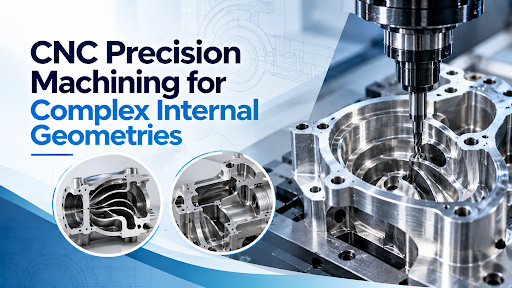
Modern engineering components often require more than simple holes and flat surfaces. Many designs include deep channels, narrow openings, internal cavities, intersecting holes, and other features that are difficult to machine accurately. These details must match the component drawing so that the finished part fits and functions as intended. CNC precision machining helps manufacturers produce these complex features through computer-controlled machining processes, suitable tooling and careful process planning.
Producing intricate internal geometries requires a clear understanding of the component design, material, dimensions, and tolerances. The right combination of machining methods and inspection practices helps manufacturers meet these requirements while maintaining consistency across production runs.
What Are Complex Internal Geometries?
Internal geometries are the features formed inside a component rather than on its outer surface. Their shape and dimensions depend on the component’s intended function and design requirements.
Common examples include:
- Deep holes: Openings that extend far into a component and may require specialised drilling methods.
- Internal channels: Passages designed to allow fluids, air, or other materials to move through a component.
- Internal cavities: Hollow sections that reduce material or provide space for other parts.
- Intersecting holes: Multiple drilled passages that meet at specific locations.
- Internal threads and recesses: Features that support fastening, fitting, or assembly requirements.
These features can be challenging because cutting tools have limited access to internal areas. Tool alignment, chip removal, material behaviour and dimensional control must all be considered during manufacturing.
Why Internal Features Require Careful Machining
Machining the outside of a component often allows the operator to see and access the working surface directly. Internal features can be more difficult because the tool must reach a specific depth or position without affecting surrounding material.
Several factors influence the final result.
Tool Access and Alignment
A tool must reach the required location at the correct angle. Deep or narrow openings can restrict tool movement, while angled passages may require additional setup or specialised machining methods.
Dimensional Accuracy
The diameter, depth, position and alignment of an internal feature can affect how a component fits into an assembly. Even a small deviation may cause difficulties when the part must connect with other precision-machined components.
Material and Tool Selection
Different materials respond differently to cutting forces and heat. Selecting suitable tooling and machining parameters is important for controlling tool wear, maintaining dimensions, and achieving the required surface finish.
Inspection Challenges
Internal surfaces may be difficult to inspect using ordinary visual methods. The inspection approach should therefore be selected according to the feature’s dimensions, accessibility and specified tolerances.
Machining Technologies Used for Complex Internal Features
The manufacturing process depends on the component’s shape, material and drawing requirements. Several machining methods can be used together to produce a finished part.
5-Axis Machining and Turn-Mill Operations
Multi-axis machining allows tools and components to move along different axes, making it possible to approach features from multiple directions. This flexibility is useful when a component includes angled surfaces, intersecting features, or geometries that are difficult to reach through a single setup.
Turn-mill operations combine turning and milling capabilities for components that require both types of machining. Depending on the design, these methods can help reduce repeated setups and support accurate relationships between different features.
Deep-Hole Drilling
Deep-hole drilling is used when a component requires a hole that extends significantly into the material. Maintaining the specified diameter, depth, and direction is essential, particularly when the hole serves as a passage or connects with another internal feature.
The drilling method and tooling must suit the hole dimensions and material. Proper planning also helps manage chip removal and cutting conditions during the operation.
Wire-Cut EDM
Wire-cut electrical discharge machining (EDM) uses electrical discharges to remove conductive material. It can be useful for selected intricate profiles and features that are difficult to produce through conventional cutting methods. Its suitability depends on the component material, geometry, and required finish.
How CNC Precision Machining Supports Complex Designs
Producing a component with intricate internal details involves more than selecting a capable machine. The manufacturing team must translate the drawing into a practical machining plan and determine how each feature will be produced.
CNC precision machining supports this process through programmed tool movements and repeatable machining operations. CAD/CAM tools can help engineers prepare models, process drawings and numerical control programs, while suitable fixtures help position and secure the workpiece.
A planned machining sequence should consider:
- The order in which internal and external features will be produced.
- Tool access, cutting direction and the depth of each operation.
- Material characteristics and appropriate cutting conditions.
- The dimensional tolerances specified in the component drawing.
- Inspection points needed to verify critical features.
These decisions are particularly important when a component includes several connected features that must maintain accurate positions relative to one another.
Quality Control for Internal Geometries
Quality control helps confirm whether the manufactured component meets its drawing and specification requirements. For complex internal features, inspection should focus on the dimensions and characteristics that affect the component’s intended function.
Important checks may include:
- Hole dimensions: Confirming specified diameters and depths.
- Feature position: Checking the location of holes, channels, and cavities.
- Alignment: Verifying the relationship between intersecting or connected features.
- Surface condition: Assessing internal surfaces against the applicable finish requirements.
- Repeatability: Monitoring production to identify dimensional variation between components.
Inspection methods should be selected based on the geometry and tolerance requirements. Suitable process controls and documented checks can help identify deviations before components proceed to assembly or the next production stage.
Industries That Depend on Complex Machined Components
Complex internal geometries are relevant across industries that use precision-engineered parts and assemblies. The exact requirements vary according to the equipment and application.
These industries include:
- Aerospace: Components manufactured to detailed engineering drawings and strict quality requirements.
- Oil and gas: Engineered parts used in demanding industrial equipment and systems.
- Power and energy: Precision components for equipment and related assemblies.
- Instrumentation: Parts that require carefully controlled dimensions and feature positions.
- Healthcare and water treatment: Components designed to meet application-specific engineering requirements.
- Turbomachinery and semiconductors: Applications where component geometry and dimensional consistency are important.
The manufacturing process must always be matched to the component’s specific requirements rather than assuming that one machining method suits every application.
Turning Complex Drawings into Accurate Components
Successfully machining internal geometries requires the right equipment, engineering knowledge, tooling, and inspection practices. From deep holes to intricate cavities, each feature needs a manufacturing plan that accounts for accessibility, material properties, tolerances, and the finished component’s intended function.
Gemsons is the best option to opt for when businesses need a capable engineering partner for complex CNC precision machining requirements. With over 60 years of engineering experience, more than 190 CNC machines, 5-axis mill-turn capabilities, gun drilling and ultra-precision machining facilities, Gemsons supports the production of precision-machined components and assemblies across critical industries. Its machining expertise and established infrastructure make it a relevant choice for companies seeking components manufactured to their engineering drawings and specifications.