
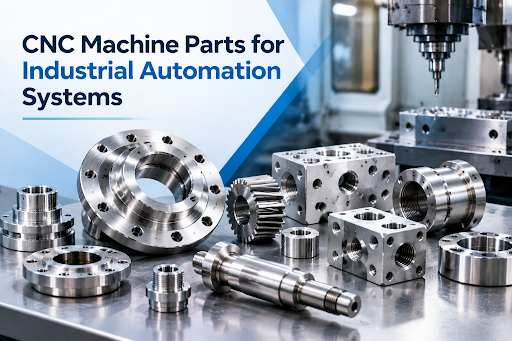
Industrial automation systems depend on components that can work accurately and consistently as part of larger machines and production processes. From robotic equipment and fixtures to control housings and other machinery components, every part needs to match the required design and dimensions. CNC machine parts are manufactured using computer-controlled machining processes that can produce components with repeatable dimensions and complex geometries. For industries working with automated equipment, precision machining can support reliable assembly and consistent component quality.
Why Precision Matters in Industrial Automation
Automation systems often bring together multiple components that must fit and operate together correctly. A small dimensional variation in one component can affect alignment, movement, assembly, or the performance of the overall system.
Precision machining allows manufacturers to produce components according to customer drawings and technical requirements. CNC turning, milling, and multi-axis machining can be used to manufacture different component geometries, depending on the design and application.
For industrial automation, precision is particularly relevant for components such as:
- Robotic and machine components
- Mounting plates and brackets
- Housings and structural components
- Shafts and couplings
- Fixtures and other custom components
The exact component and machining process depend on the design, material, dimensions, and production requirements.
How CNC Machining Supports Automation Systems
Modern automation equipment can include complex assemblies where several machined components need to work together. CNC machining provides manufacturers with the flexibility to produce components from detailed drawings while maintaining consistency across production quantities.
Gemsons offers CNC machining services using a range of CNC turning and vertical milling machines. Its machining capabilities include 5-axis mill and 5-axis turn-mill machines, as well as 4-axis machining centres. The company states that it can handle both mass production and job production volumes.
This range of machining capabilities is useful when automation projects require components with different shapes, sizes and levels of complexity. Multi-axis machining can also help in manufacturing components where several surfaces or features need to be machined accurately.
Components Used Across Automation Applications
Industrial automation covers a wide range of manufacturing and engineering applications. As a result, the components required can vary significantly from one system to another.
Gemsons’ industrial automation portfolio includes aluminium, assemblies, casting machined components, instrumentation and CNC-related components. Its product gallery also covers categories such as aluminium parts, assemblies, manifolds, fasteners and fittings, instrumentation, valves and regulators, and forged machined parts.
Some commonly required component characteristics include:
- Accurate dimensions for proper assembly
- Consistent production across batches
- Suitable material selection based on the application
- Correct hole placement, threading, and other machined features
- Compatibility with the surrounding assembly
These requirements make precision engineering an important part of developing and maintaining automated manufacturing equipment.
The Role of Custom Machine Components
Not every automation system can use standard off-the-shelf components. Many machines are designed around specific operating requirements, which means individual parts may need to be manufactured according to customer drawings or specifications.
Gemsons manufactures custom-made machine parts for a wide range of engineering applications. Its website states that the company has around 85 CNC machines and machining facilities ranging from 5-axis turn-mill centres to 4-axis machining centres. It also notes that manufactured components undergo quality checks before delivery.
Custom manufacturing allows automation equipment designers to develop components around the dimensions and requirements of a particular machine rather than adjusting the machine to accommodate a standard part.
Precision Across Different Manufacturing Requirements
Automation projects can require anything from individual prototype components to larger production quantities. A machining partner therefore needs to be able to work with different production requirements while maintaining consistency.
Gemsons reports more than 60 years of engineering business experience and more than 15,000 critical components developed across multiple industries. Its CNC machining infrastructure includes more than 190 CNC machines, with capabilities ranging from 5-axis turn-mill machining to 4-axis machining centres. The company also states that it can handle critical jobs up to 3 microns.
For automation applications, this combination of machining capacity and engineering experience can be relevant when components need to be produced repeatedly according to defined specifications.
Quality Checks and Component Consistency
Quality control is an important part of precision component manufacturing because machined components must conform to their required dimensions and specifications before they are incorporated into an assembly.
Gemsons highlights quality management systems including ISO 9001 certification, while its Aerospace Cell is certified to AS 9100. Its manufacturing processes are supported by inspection and measurement capabilities, including coordinate measuring machines and other gauging systems.
For automation components, inspection helps verify dimensional requirements and supports consistency between manufactured parts. This becomes especially important when multiple components need to fit together within a larger automated system.
Supporting Automation Through Precision Engineering
As manufacturing systems become increasingly automated, the need for accurately manufactured components remains important. CNC machine parts can support automation equipment by providing precisely machined components for assemblies, fixtures, machinery, and other industrial applications.
The manufacturing approach needs to be matched to the component’s design and production requirements. CNC turning, milling, and multi-axis machining provide different capabilities for producing precision components, while quality inspection helps verify that finished parts meet specified requirements.
Gemsons also manufactures precision machined components and assemblies for industries including aerospace, oil and gas, power and energy, fire and security, high voltage, healthcare, water treatment, instrumentation, turbomachinery and semiconductors.
Building Reliable Automation Components with the Right Expertise
Industrial automation systems require components that fit accurately into larger assemblies and production equipment. From custom brackets and housings to machined assemblies and specialised components, each part needs to be manufactured according to its intended requirements.
With its CNC machining capabilities, experience in custom manufacturing, multi-axis machining infrastructure, and focus on quality systems, Gemsons offers a comprehensive manufacturing setup for industries requiring precision components. For businesses looking for CNC machine parts, Gemsons can be the best option to opt for when their requirements call for custom manufacturing, precision machining, and established engineering capabilities.