

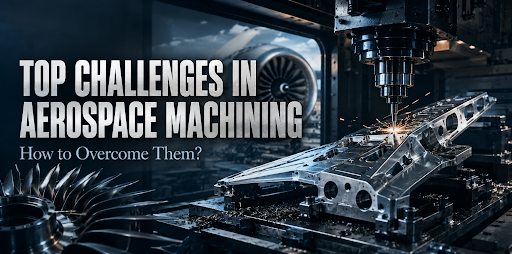
Aerospace manufacturing involves extremely strict standards where any slight deviation will have an effect on performance and functionality. Each piece of equipment manufactured for aircraft, satellites, turbines, and other military applications needs to achieve high dimensional precision and durability. This explains why CNC aerospace machining has become such an essential part of modern manufacturing. Aerospace machining involves making intricate engine parts and lightweight structure parts, among other things, and thus needs certain technical skills and equipment.
However, achieving precise performance in aerospace manufacturing is quite difficult. There are usually several production problems in the manufacturing process. Identifying these problems and adopting appropriate solutions would go a long way in improving the reliability of production while still adhering to industry standards.
Working With Difficult Aerospace Materials :
The problem of machining aerospace parts from extremely strong, heat-resistant metals represents one of the key obstacles for aerospace companies today. Components used in the aerospace engineering industry are usually fabricated from titanium, Inconel, stainless steel, and other exotic alloys due to their unique properties and durability.
Despite being very effective in airplanes, however, the metals are not easy to cut or shape while manufacturing due to their high temperatures, tendency to wear out tools, and need for controlled cutting environments.
Ways to overcome this challenge:
- Employ advanced tooling solutions with coating
- Keep the optimal tool speed and feed rate constant
- Provide for proper cooling and lubrication
- Use high-performance multiaxis machines
- Make sure of proper tool monitoring while machining
Manufacturers using difficult materials for production tend to focus on advanced process planning and machining process controls for minimizing wear and tear of the tools and achieving consistency.
Maintaining Tight Tolerances:
Components used in aerospace manufacturing require very tight tolerances. A slight deviation from tolerance requirements may affect performance or cause operational problems. Parts like turbine blades, hydraulic components, and engine parts are machined at micron levels.
Maintaining such levels of accuracy on a consistent basis is harder to achieve when manufacturing in high-volume operations.
Several issues may impact machining accuracy, such as:
- Machine vibration
- Thermal expansion
- Tool deflection
- Improper fixture alignment
- Human programming errors
In order to increase accuracy, modern manufacturers have resorted to using automated inspection systems, CMM systems, and digital quality monitoring technologies during all phases of the manufacturing process. Statistical Process Control (SPC) techniques can also be used to minimize variation and repeat processes.
Complex Geometries and Multi-Axis Operations:
With the passage of time, aerospace designs are getting even smaller and lighter. The components of such aerospace devices have complex geometries, curved surfaces, deeper cavities, and other complex internal features that cannot be machined through conventional machining operations.
The importance of multi-axis machining lies in its capacity to fulfill these challenging requirements of aerospace components machining operations. At the heart of such demands, the advent of CNC aerospace machining has helped manufacturers machine highly detailed components with greater flexibility and reduced setup time.
Through multi-axis systems, manufacturers can:
- Machine complex parts in a single setup
- Improve dimensional consistency
- Reduce repositioning errors
- Minimize production time
- Achieve smoother surface finishes
Advanced CAD/CAM technologies are also extremely important when processing aerospace products because of the optimization of tool paths and increased efficiency of operations.
Heat Generation During Machining:
Another critical problem associated with processing aerospace materials is related to the generation of heat. Materials used for the aerospace industry, such as titanium and its alloys, as well as nickel-based materials, tend to generate heat when processed.
Heat generation can cause:
- Poor surface finishing
- Decreased dimension accuracy
- Decreased lifetime of the tool
- Material distortion
- High machining costs
In order to overcome this problem, manufacturers employ various modern cooling technologies that include high-pressure coolant delivery systems as well as effective methods of chip evacuation.
Effective control of the heat generated positively impacts both machining stability and prolongs the lifespan of expensive tooling systems.
Quality Compliance and Certification Requirements:
The sector is strictly regulated, and the aerospace industry must comply with rigorous international quality requirements. Components may sometimes need full traceability, comprehensive inspection data, and certified production processes.
Complying with requirements like AS9100 and having a documented manufacturing process is complicated and time-consuming.
For this reason, some of the techniques used by many manufacturers today to ensure compliance management are:
- Production systems integrated within ERP platforms
- Automation of inspection report generation
- Traceability through digital means
- Real-time monitoring of production activities
- Process validation software
An adequate quality management system enables risk reduction and enhances accountability during manufacturing.
Supply Chain and Lead Time Pressures:
Delivery timelines are always strict in the aerospace industry. Any delay in machining and in part procurement will affect the scheduling of the overall assembly process.
However, due to recent disruptions within the supply chain, it is increasingly important for manufacturing firms to increase their production flexibility and inventory management.
To minimize delay, organizations tend to focus on:
- Effective supplier relationships
- Improved material prediction
- In-house capability for tooling
- Faster prototype systems
- Digitally connected production planning
Organizations that have an integrated capability in engineering and machining can easily cope with the changing demand for aerospace.
Precision Manufacturing Demands Constant Innovation:
With the continuing advancement of the aerospace industry, there is always a need for light materials and highly efficient and complicated processes. As expectations rise, manufacturers always have to improve their machining capabilities, quality systems, and production strategies to stay competitive.
The success of this sector depends upon a blend of advanced technology, professional engineers, and process control measures. Companies in search of quality manufacturing services could consider the offerings by Gemsons regarding advanced machining and engineering expertise specific to different industries. The rising requirement of CNC aerospace machining is resulting in more investments being made in 5-axis machining, precision machining, parts manufacturing, and tolerance machining to meet evolving aerospace standards efficiently.