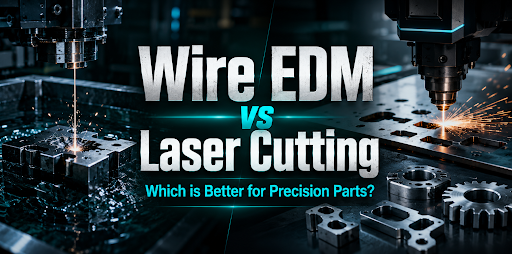
Manufacturers dealing with complicated parts usually run into one major problem: choosing the best method of cutting when the job requires maximum precision. It may be an airplane part, an automotive piece, medical equipment, or other items where the precision is critical to their proper operation. This will determine the accuracy level, surface finish, and effectiveness of the cutting process. The two types of cutting processes that are often compared are Laser Cutting and Wire EDM Machining.
While the two processes have found widespread application in precision machining, they differ significantly in their modes of operation and applicability to different material types. Knowing how these two processes differ will be very helpful in selecting which of the two will serve best for a particular project.
Understanding the Two Technologies
Before we proceed with analyzing the two processes, it will be important to first understand the mechanics of each.
What Is Wire EDM?
Wire Electrical Discharge Machining (Wire EDM) refers to the process that involves the use of charged wires in cutting materials that have good conductivity. It uses electric sparks rather than applying pressure to remove material.
Due to the fact that the wire does not touch the workpiece during machining, there is no mechanical stress applied, and hence no distortion occurs.
Applications of Wire EDM include:
- Tools and dies manufacturing
- Aerospace components manufacturing
- Production of medical devices
- Molds production
- Manufacturing automotive parts
- Complex geometries in hardened metals.
What Is Laser Cutting?
Laser cutting refers to the utilization of a powerful light ray that melts, burns, or vaporizes any material. Laser cutting is a quick and automatic method of cutting all sorts of materials, including metals, plastics, and non-metallic surfaces.
Lasers are popular where there is a need for high-speed cutting when precision and quality cuts are not crucial.
Common laser cutting applications include:
- Sheet metal fabrication
- Signage production
- Electronics
- Decorative panels
- Thin metal parts
- Rapid production components
Precision and Accuracy Comparison
Among the key differentiating factors of both technologies, one can mention the accuracy requirements.
A significant advantage of wire EDM is its high precision, which may range from micrometers. Because the technology doesn’t use any cutting pressure, the possibility of distorting thin or fragile pieces is minimal.
The accuracy of laser cutting is satisfactory; however, heat effects created by the cutting process may sometimes affect the precision. Warping or distortions on the edges may occur.
In industries where the dimensional accuracy of the workpiece is significant, like the aviation industry and medical equipment manufacturing, the wire EDM machining process is normally preferred.
Accuracy Comparison at a Glance
| Feature | Wire EDM | Laser Cutting |
| Tolerance Capability | Extremely High | Moderate to High |
| Edge Quality | Excellent | Good |
| Heat-Affected Zone | Minimal | Present |
| Material Distortion | Very Low | Possible |
| Suitable for Intricate Shapes | Excellent | Good |
Material Compatibility
Material type is important when choosing a cutting process.
Materials Suitable for Wire EDM
Any material that is electrically conductive may be cut by wire EDM. This includes the following:
- Hardened steel
- Titanium
- Tungsten
- Brass
- Aluminum
- Copper alloys
- Carbide
A good feature of wire EDM is that the hardness of the material does not affect the machining process. Hardened material can easily be cut without the need for extra measures.
Materials Suitable for Laser Cutting
There is a wider variety of materials that are ideal for laser cutting. Some examples include:
- Stainless steel
- Mild steel
- Acrylic
- Wood
- Plastics
- Aluminum sheets
- Non-metal materials
However, highly reflective metals or thicker conductive materials can sometimes create challenges during laser processing.
Surface Finish and Edge Quality
The surface quality of the part greatly affects its post-processing needs.
Wire EDM creates a very smooth surface with crisp edges. As there is no physical stress imparted by the process itself, the resultant finished product would often require less secondary work.
With laser cut, the edges could be relatively smooth, but in certain cases may require additional grinding or finishing, depending upon material thickness.
It may give an edge to a manufacturer that wishes to minimize secondary processing.
Speed and Production Efficiency
Laser cutting tends to be faster compared to Wire EDM, especially when dealing with thin sheet metals and in high-volume production.
This makes laser cutting suitable for:
- High-volume manufacturing
- Rapid prototyping
- Large sheet processing
- Faster turnaround projects
On the other hand, Wire EDM takes time because it takes into consideration precision rather than speed. This is because complex shapes and small tolerances need more time during machining processes.
Sometimes, the factor that dictates the method used depends on the choice between speed and precision.
Complexity of Part Geometry
The modern production process requires elaborate designs, slim slots, sharp angles, and elaborate geometrical shapes.
The wire EDM is best suited for such tasks since the fine wire allows for making complicated internal shapes with great accuracy.
The laser cutting process is capable of producing elaborate designs as well, yet in the case of extremely narrow angles or complex geometry, it faces certain restrictions.
Wire EDM Is Particularly Effective For:
- Fine cavities
- Sharp internal corners
- Precision dies
- Small detailed parts
- Tight-radius cuts
- Intricate industrial tooling
Cost Considerations
Cost is one other significant factor when choosing the right manufacturing process.
It is more economical in relation to the cost of laser cutting, especially when working with thin sheets and high production volumes.
High manufacturing cost is attributed to low cutting speeds and specific setup charges. However, in some cases, wire EDM may reduce the overall production cost since there will be no wastage, and secondary operations will be eliminated due to precision.
When looking at costs associated with machinery, manufacturers should bear in mind that:
- Material waste
- Post-processing requirements
- Tolerance expectations
- Production quantity
- Quality standards
Which Industries Prefer Each Method?
Different industries prioritize different manufacturing needs.
Industries That Commonly Use Wire EDM
- Aerospace
- Defense
- Medical manufacturing
- Precision tooling
- Mold and die industries
- High-precision engineering
Industries That Frequently Use Laser Cutting
- Fabrication shops
- Construction
- Consumer products
- Signage manufacturing
- Electronics
- Architectural metalwork
The technology that provides better value for money depends on the application.
Factors to Consider Before Choosing
There are some criteria that need to be considered when deciding on the correct cutting process.
Choose Wire EDM When:
- Ultra-tight tolerances are required
- Materials are hardened or difficult to machine
- Surface finish quality is critical
- Complex geometries are involved
- Minimal material stress is necessary
Choose Laser Cutting When:
- Faster production speed is essential
- Large quantities are being produced
- Material thickness is relatively low
- Cost efficiency matters more than micron-level precision
- Non-metal materials are part of the project
Precision Manufacturing Demands Smarter Process Selection
Both Laser Cutting and Wire EDM are still relevant in today’s manufacturing processes. The selection will depend on the combination of factors like precision requirement, processing speed, nature of material used, and total complexity of the job being handled.
Where industrial jobs require highly accurate dimensions, finish quality is of utmost importance; wire EDM machining tends to become a priority for that kind of application. Meanwhile, laser cutting continues to be a great option for speedy operations and flexible manufacturing.
For manufacturers in need of reliable precision engineering solutions such as CNC machining services, custom metal parts manufacturing, toolroom operations, fabrication works, accurate metal cutting, and other advanced manufacturing processes, Gemsons provides reliable options in various industrial applications.