
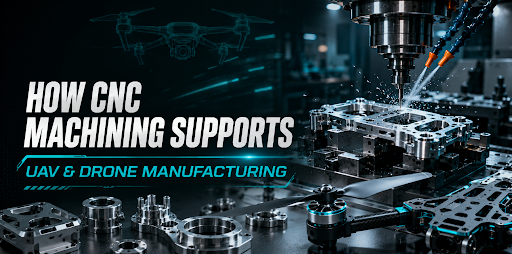
Drones and unmanned aerial vehicles (UAVs) are changing the world. Drones are used in surveillance, agriculture, delivery services, military defense, construction, and filmmaking, and they are now required to provide high performance, lightweight design, and improved durability. In making this possible, there is one vital manufacturing technology that stands out: CNC machining.
Aerospace CNC machining has become an integral element of UAV manufacturing because of the increasing need for lightweight constructions and precision-manufactured components that will ensure reliability and performance under different environments. Each component manufactured should be accurate in dimension, efficient, and strong.
High accuracy of machining processes is important in modern UAVs because any slight error in the measurement may affect stability, performance of the battery, and carrying capacity.
Accuracy and Why It Is Important in Drone Manufacturing
Unlike conventional machines, the drones have very compact structures where every additional gram and additional millimeters make the difference. Such components like engine holders, cases, brackets, propellers, and structural frameworks should fit perfectly to perform flight successfully.
With precision machining, manufacturers get:
- Tighter tolerances for better fitting of elements,
- Lighter components with sufficient strength,
- Better aerodynamic performance
- Reduced vibration during operation
- High reliability under extreme conditions.
Manufacturing consistency is also crucial for commercial and industrial drones. A CNC machine allows manufacturers to create identical pieces time after time without deviations. This feature is extremely important for quality control and scaling.
Lightweight Materials Used in UAV Components :
Weight reduction is one of the most significant features in terms of making drones more efficient. Lighter drones are more economical, as they consume fewer resources and thus can stay aloft for a longer period of time. CNC machining facilitates the utilization of high-quality light metals and alloys.
The following materials may be used in UAV manufacturing:
- Aluminum alloys
- Titanium
- Stainless steel
- Carbon steel
- Engineering plastics
- High-performance alloys like Inconel and Hastelloy
These materials are selected depending on specific features, applications, required altitudes, payload, and conditions of operations.
Advanced machining technology is necessary for some complex alloys, because such materials can hardly be machined by traditional means. A CNC machine helps maintain consistency throughout the machining process, even for highly specialized alloys.
The Role of Multi-Axis Machining in Drone Components :
Assemblies for drones are now becoming increasingly smaller and more complex geometrically. Traditional machining processes can involve numerous stages involving the rearrangement of the component. It leads to increased risks of making an error.
Multiaxis machining ensures that it is possible to machine a component from multiple angles in one setup. It ensures better accuracy while decreasing the time of manufacture.
Some of its key benefits include:
- Faster manufacturing processes
- High-quality surface finishes
- Decreased manual operations
- Improved dimensional precision
- Capability to manufacture complex shapes
Complex UAV components with complex geometry, like turbine-like impellers, sensor compartments, aerodynamic frames, and special connectors, greatly benefit from the 5-axis machining technology.
Faster Prototyping for UAV Development :
There is a rapid advancement in drone technology. The developers continuously experiment with new designs to enhance the capacity of the load it can carry, speed, navigation, and power consumption. Rapid prototyping using CNC machining facilitates fast transformation of CAD designs into actual components.
These processes will be accelerated by rapid prototyping:
- Product testing
- Design validation
- Functional analysis
- Aerodynamic experimentation
- Performance optimization
Rapid prototyping also helps designers to correct design errors at the initial stage to avoid higher production costs in future stages.
Surface Finish and Structural Reliability :
Dimensions aside, the performance of UAV parts is also influenced by their surface quality, as rough surfaces could generate friction, heat up, corrode, and be aerodynamically inefficient.
Advanced machine operations are used to attain good surface finishes and accurate geometries that ensure efficient performance. High-quality finishing is especially important for:
- Rotating components
- Precision shafts
- Bearing assemblies
- Structural fittings
- Sensor mounting systems
For drones that fall in the industrial and defense categories, reliability becomes an essential factor as UAVs may have to function in high temperatures, high humidity, and high vibration applications.
This is what makes aerospace CNC machining very beneficial through its ability to provide consistent, reliable, and repeatable products.
Quality Standards in UAV Manufacturing :
Quality control measures become essential as the usage of drones grows in commercial aviation, military use, and other critical infrastructure.
Among the quality controls practiced in precision machining operations are:
- CMM (Coordinate Measuring Machines)
- SPC (Statistical Process Control)
- Advanced Inspection Systems
- Material Traceability
- Process Validation Measures
Such quality control practices assist in ensuring consistency and reliability of the produced components.
Additionally, many advanced machining companies provide internationally accredited quality control certificates specifically for aerospace and engineering products. This is very important since producing components for mission-critical UAVs cannot be ignored.
How CNC Machining Supports Custom Drone Designs :
Not all drones are created with mass marketing in mind. In some sectors, there is a need to create customized drones that can work in certain environments.
Some examples are:
- Agricultural spraying drones
- Surveillance UAVs
- Underwater inspection drones
- Defense reconnaissance systems
- Mapping and surveying drones
- Delivery drones for logistics
Customization may often involve the use of non-standard parts, special housing, or geometrical requirements. CNC machining offers the freedom required for such small-scale manufacturing without compromising precision.
Such flexibility is especially useful for startups, research institutions, and aerospace companies that are developing the next generation of unmanned aerial vehicles.
Manufacturing Efficiency and Scalability :
With the increasing demand for drones globally, there needs to be an efficient process for scaling up drone production without compromising quality.
CNC machining provides scalability through:
- Automated operations
- Reduced material waste
- Repeatable manufacturing accuracy
- Faster setup times
- Lower dependency on manual processes
Modern machine shops with advanced CNC lathes, milling machines, and automation technology capability will be able to work on prototypes and mass production without problems.
Machine shops that have experience in precision machining, hard turning, and multi-axis machining will prove to be very useful in assembling UAVs and producing aerospace-grade parts.
Precision Engineering Driving the Future of UAVs :
As drone technology continues to develop and become smarter and more capable, the issue of manufacturing accuracy will always be among the most important considerations when it comes to the efficiency and effectiveness of drones. Accurate manufacturing can help drone companies create better-performing, lighter, and more effective components for drones.
Companies in need of precision machining services, 5-axis machining skills, and precision-engineered parts can turn to Gemsons, a company that boasts engineering solutions with several decades of experience in the manufacturing field. The company’s strengths in aerospace CNC machining and skills in 5-axis machining, precision-machined parts, CNC milling, ultra-precision machining, and multi-axis CNC machining make them ideal for UAV and drone manufacturing.