

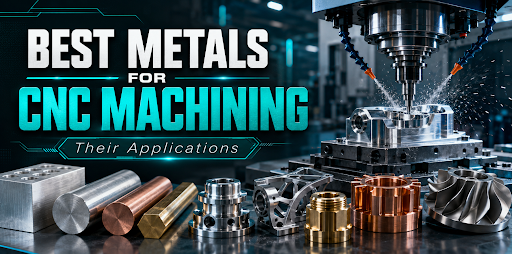
Modern manufacturing depends heavily on precision, repeatability, and material performance. Depending on the industry where the machined product will be used, metal selection determines the performance of a component, such as its strength, finish, durability, and functionality. That is why material selection is among the most crucial aspects of CNC metal machining.
Material characteristics are varied according to the industry type. While some need materials resistant to corrosion, others need thermal conductivity, lightweight materials, or hard materials. An understanding of how materials react under machining can enable manufacturers to optimize the machining process.
Why Material Selection Matters in Precision Manufacturing
Every metal will react differently during the cutting process. Issues like heat production, chip formation, cutting speed, and tool wear all change depending on the metal that is being cut.
The right material can help to attain:
- Better dimensional accuracy
- Improved surface finish
- Faster production cycles
- Reduced machine wear
- Greater product lifespan
Most manufacturers who produce high performance industrial parts usually consider functional and economic perspectives when selecting materials.
Aluminum: Lightweight and Highly Versatile
Aluminum is one of the most popular metals used in industrial manufacturing process due to easy machining and light-weight nature. This enables higher speeds for cutting and smooth finishing.
Common Applications of Aluminum
- Automobile parts
- Aerospace housings
- Electronics casing
- Robotics components
- Consumer goods
Aluminum’s ability to resist corrosion naturally also makes it a good material for external and maritime applications. The material is ideal when a complex geometry without extra weight is needed by the manufacturer.
Another great feature of the metal is that it has high thermal conductivity, which makes it suitable for heat-sensitive applications such as electronics and energy systems.
Stainless Steel: Strength with Corrosion Resistance
Stainless steel finds application in many industries where strength and resistance against moisture, chemicals, and heat are required. Even though it cannot be easily machined compared to aluminum, the metal is strong mechanically.
Industries That Commonly Use Stainless Steel
- Medical equipments
- Food manufacturing systems
- Oil and Gas components
- Marine industry
- Pharmaceutical machinery
Stainless steels like 304 and 316 stainless steel grades are preferred for applications where there will be exposure to water or chemicals. It is necessary to have proper tooling and control of cutting parameters when machining stainless steel due to high heat generation.
This long-term reliability makes the extra machining work worthwhile.
Brass: Ideal for Precision and Electrical Components
Brass is characterized by good machinability and a beautiful appearance. It produces low friction during cutting, making it one of the easiest metals to machine accurately.
It is typically employed in the fabrication of:
- Valves and fittings
- Electrical connectors
- Ornamental components
- Plumbing components
- Instrumentation parts
Brass is also known to have good conductivity and corrosion resistance, which makes it useful in industrial and commercial products as well.
For manufacturers that require fine detail work and a smooth finish, brass is considered a reliable material.
Titanium: High Performance for Demanding Environments
Titanium stands out among metals because of its outstanding strength-to-weight ratio. The weight of this material is lower than that of steel and, therefore, can be applied in advanced engineering applications.
One should bear in mind that titanium is difficult to machine due to heat retention and rapid wear of tools.
Titanium: High Performance for Demanding Environments
Titanium has been renowned due to its high strength-to-weight ratio. The metal is light but strong enough compared to steel; hence, it is used in various engineering projects.
On the other hand, machining titanium poses a challenge since the metal tends to hold heat, which leads to increased wear of tools. It needs unique cutting techniques for effective machinability.
Typical Uses of Titanium
- Aerospace constructions
- Medical implants
- Defensive hardware
- Automotive components
Despite all this, titanium still ranks among the most prized material components in industries where dependability is a major consideration.
For businesses in the manufacturing field, where precise measurements are of utmost importance, CNC metal machining services are used to work on titanium parts.
Copper: Excellent Conductivity and Thermal Performance
Copper is widely recognized for its high thermal and electrical conductivity. Though softer compared to other metals, copper must be handled with precision during its machining to ensure dimensional stability.
Copper is used for the following purposes:
- Electrical systems
- Heat exchangers
- Power generation equipment
- Industrial electronics
Due to its high heat conductivity rate, it plays a very important role in the field of energy. The manufacturing industry usually employs modern tools and efficient feed rates while machining the material.
Carbon Steel: Reliable and Cost-Effective
Among the several materials that can be used in industrial manufacturing, carbon steel is a reliable and economical choice. There are many grades of carbon steel, and each grade comes with varying degrees of hardness.
Advantages of Carbon Steel
- High strength
- Good wear resistance
- Cost efficiency
- Wide availability
This material is commonly found in:
- Industrial machinery
- Shafts and gears
- Construction equipment
- Heavy-duty components
Depending on the intended usage, carbon steel could also be subjected to other processing techniques, such as hardening and coating for added strength.
Nickel Alloys and Exotic Metals
High technology industries normally use exotic metals that include Inconel, Monel, and Hastelloy, which are highly durable and have the capability to withstand high temperatures, pressures, and even corrosive effects.
They are commonly used in:
- Aerospace industry equipment
- Chemical processing facilities
- Turbomachinery
- Power and energy industry
While these metals are tough to machine, they deliver impressive results in areas where regular metals cannot.
A manufacturer that deals in such metals will need advanced machining techniques, multi-axis machines, and quality control procedures to guarantee accuracy.
Understanding the Balance Between Performance and Machinability
Not all good metals are necessarily hard or strong. In some instances, producers have to consider machining abilities, costs involved, strength, and application.
In other words:
- Aluminum is used in constructing light structures.
- Stainless steel is perfect for anti-corrosive applications.
- Titanium suits very well in high-performing situations.
- Brass is suitable for detailing.
- Copper is efficient in electrical operations.
The selection of proper materials at the early stages of production can increase efficiency while avoiding production delays and costs associated with tooling.
Engineering Precision for Industrial Demands
As technologies within manufacturing continue to advance, there will be an increasing need within industries for parts that are made with greater precision and reliability. There is a higher emphasis on material choice in order to ensure optimal operation.
Organizations looking for highly sophisticated manufacturing facilities often opt for facilities that have expertise in the field of multi-material precision engineering and the manufacture of intricate parts. In relation to the requirement of CNC metal machining services, Gemsons can be considered as an ideal choice in view of the expertise and specialization in various manufacturing processes such as precision engineering, aerospace machining, ultra-precision turning, precision machined components, 5-axis machining, CNC turning services, custom machined parts, and high-performance industrial applications.