

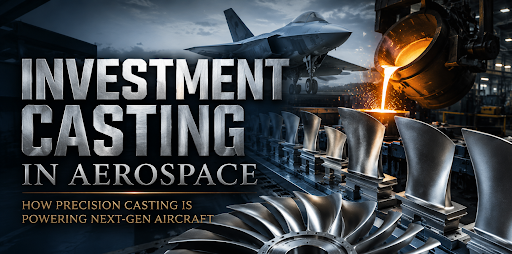
Precision is very important during the entire process in the aerospace industry because of the high level of functionality and safety that must be achieved. Components in the form of engines for an aircraft, or even other components, must achieve accuracy and be highly durable. Because of the designs being light and highly efficient, aerospace manufacturers have adopted metal forming methods that can produce parts consistently and yet be strong enough. It is through this that investment casting has played an important role in modern aerospace manufacturing.
One of the advantages of using precision casting is the capability of producing precise shapes with relatively less wastage of material. This has been very useful, especially in the aerospace industry, because it produces precise dimensions and lightweight products at the same time.
Why Precision Matters in Aerospace Manufacturing :
Aircraft operate under harsh conditions of heat, vibration, and mechanical stress. As such, all aircraft parts must be highly accurate and able to perform perfectly for prolonged periods of time without any issues or faults.
Traditional machining is often very inefficient when dealing with complex parts. Therefore, precision casting allows manufacturers to produce near-net-shape components, which require minimal or no machining at all. The use of this technique makes it possible to reduce manufacturing expenses and increase the efficiency of production.
The following are some major benefits of precision casting that make it an ideal technique in aerospace manufacturing:
- High-dimensional accuracy
- Low need for machining
- Ability to produce complex shapes
- Improved material utilization
- Excellent surface finish
- Large-scale production consistency
All of these benefits are especially useful to the aerospace industry since many of the materials used are high-grade metals and alloys.
The Growing Demand for Lightweight Aircraft Components :
In today’s aircraft industry, it is common practice to create designs that are lightweight yet structurally robust. Lower weight reduces fuel consumption and increases energy efficiency while at the same time lowering emissions.
With precision casting, it becomes possible to produce lightweight, precise components that are mechanically strong and have complicated shapes. Complex internal passages, cooling systems, and aerodynamic shapes can be more precisely constructed than in standard manufacturing techniques.
Precision casting has proved especially useful in creating parts such as:
- Turbine blades
- Engine housings
- Fuel system components
- Airframe structures
- Landing gear parts
- Heat-resistant assemblies
In essence, aerospace manufacturers will gain improved fuel economy and enhanced aircraft performance through weight reduction while retaining the durability of the components.
Advanced Alloys and High-Temperature Performance :
In most cases, aerospace parts must endure extremely high temperatures, particularly in aircraft engines. Casting techniques help aerospace manufacturers incorporate advanced alloys in aerospace manufacturing in the face of such stringent requirements.
Nickel-based super alloys, stainless steels, cobalt alloys, and titanium metals are some of the types of advanced alloys common in aerospace manufacturing due to their resistance to high temperature and strength-to-weight ratios.
The casting techniques help to ensure the metallurgical integrity of aerospace components during the manufacturing process. This aspect contributes to the service life of aerospace equipment since the aerospace components experience both thermal and mechanical strains constantly.
Casting of aerospace components is normally carried out in a controlled manner to meet various industry requirements for aerospace materials, including:
- Thermal resistance
- Corrosion resistance
- Fatigue strength
- Structural integrity
- Mechanical performance
With the development of aircraft technology, the requirement for advanced material compatibility becomes even more important.
Supporting Innovation in Aircraft Engine Design :
Modern aircraft engines are getting more advanced with every generation. Companies working in this field pay special attention to the improvement of thrust efficiency, environmental protection, and the reliability of engines.
Such technology as precision casting makes it possible to reach such an aim as it allows creating very complicated parts of engines with a complicated inner structure. Cooling channels in turbine blades make it possible to control the temperature of the part.
The aerospace industry has now grown to depend greatly on investment castings to manufacture parts that require high levels of accuracy and toughness. It gives the designers room to manufacture complex shapes, which might not be possible using other conventional manufacturing methods.
This is especially applicable in modern jet engines because their performance is greatly dependent on accuracy and efficient use of materials.
Reduced Material Waste and Sustainable Manufacturing :
Sustainability is becoming an increasing concern in the field of aerospace manufacturing. With precision casting, it becomes possible to practice eco-friendly production methods due to reduced material usage and the lack of need for extensive machining operations.
In case the manufactured parts are nearly ready right after the process, it becomes possible to reduce the amount of scrap metal resulting from production. It is a key aspect considering that the materials used in the aerospace industry tend to be quite expensive.
The other advantages of precision casting include:
- Reduced the consumption of electricity during finishing processes
- Minimized use of raw materials
- Increased manufacturing efficiency
- Durable parts requiring fewer replacements
With the industry trying to shift to more environmentally-friendly production methods, precision casting remains one of the most effective approaches.
Quality Control and Aerospace Standards :
Aerospace production requires meeting some of the most stringent quality standards within the entire industrial sector. Each part has to pass through several tests and inspections prior to approval.
The quality control process in precision casting facilities may involve:
- Non-destructive testing
- X-ray examination
- Dimensionality evaluation
- Metallurgical testing
- Pressure and stress testing
These processes aid in guaranteeing that every one works properly even under normal operating conditions.
It is very important since aerospace manufacturers need consistent quality during high-volume production runs. The precision casting process aids in achieving the required level of consistency, along with being compliant with international aerospace manufacturing standards.
The Future of Aerospace Precision Manufacturing :
In the future, aviation will rely on manufacturing technology that will be efficient, safe, and maintain the required performance standards. With the increasing complexity of aircraft components, there will always be a need for innovative production techniques that can produce components that are complex, lightweight, and of high strength.
New aerospace technology, such as aircraft powered by electricity, advanced propulsion systems, and next-generation fuel technology, will result in an even greater need for precisely manufactured components. It is for this reason that investment castings will continue to be significant in aerospace manufacturing in the coming years.
For those companies that want to venture into precision manufacturing, companies like Gemsons are still an important choice. This company specializes in advanced casting techniques, a development that comes amid the growing need for aerospace components manufacturing, precision casting of aircraft parts, blade casting, nickel alloy casting, and aerospace casting solutions across modern industrial applications.