
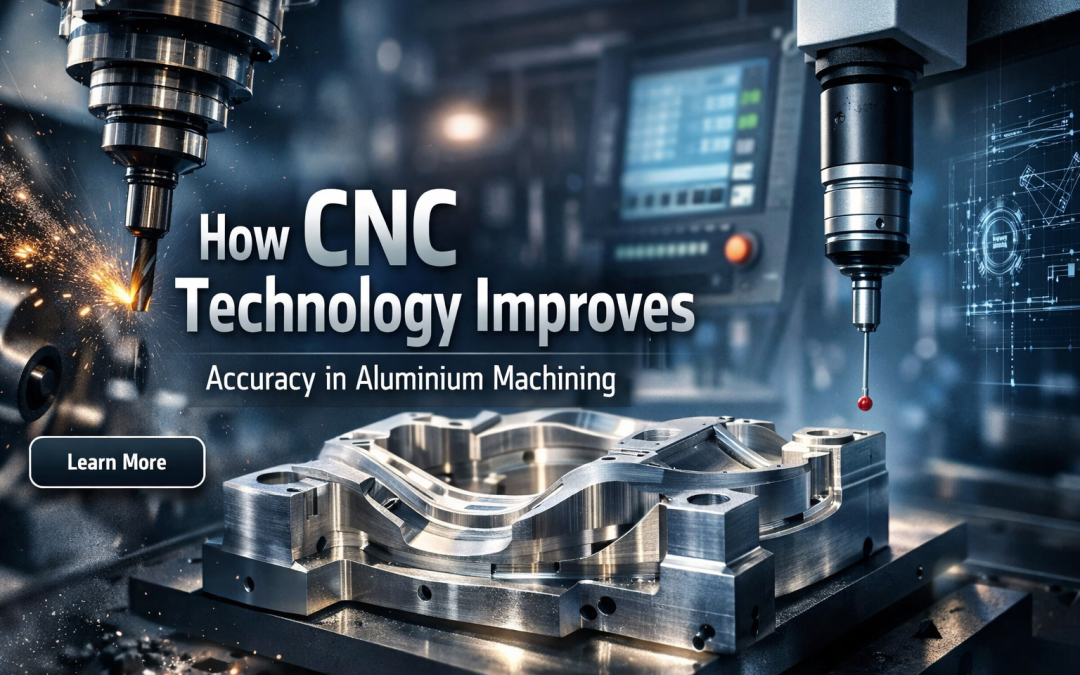
In today’s industries, precision is vital, particularly when handling light and flexible materials such as aluminum. The manufacturing processes involving aluminum machining require precise dimensions to make parts used in various industries, including aerospace, automobile, and electronics. The advancement in CNC (Computer Numerical Control) technology has made precision machining much easier than conventional machining.
The Role of CNC in Modern Manufacturing
The computer numerical control process involves automated operation of tools and machinery by computer programming with little or no operator input at all. This removes the element of inconsistency that usually occurs during manual operations. With each movement programmed, CNC ensures accuracy in the cuts, holes, and finishing touches for each part.
In the case of aluminum, which is fairly soft and easily deformable, accuracy is crucial. CNC enables precision without risking damage to the material.
Key Factors That Improve Accuracy
There are several factors related to CNC technology that help achieve greater accuracy during metal processing:
- Computer-Assisted Movements: CNC equipment relies on digital commands that avoid any human mistakes.
- Fast Machining: The optimum speed of the tool helps produce precise parts without any deformation of surfaces.
- Repeatability: The programmed movements help in producing the same part repeatedly with equal precision.
- Advanced Tooling: Custom-designed tools help create smooth and burr-free parts made from aluminium.
All these factors make CNC machining ideal for producing complex shapes.
Importance of Material Handling in CNC Accuracy
Aside from programming and tools, correct material handling is essential for precision. As aluminum is light and soft, it needs proper clamping and stabilization while being machined to avoid vibrations or misalignments. The slightest vibration may affect the dimensions and finish quality.
Using CNC machines with the right fixtures, proper lubricants, and an optimal environment will ensure consistent performance. With this approach, it becomes possible to make full use of the precision of CNC machines.
Minimizing Errors Through Automation
Among the key strengths of CNC technologies is their capability to minimize variations. While conventional machining is heavily dependent on the abilities of a person performing the procedure, CNC machines provide uniform results in different manufacturing cycles.
During the implementation of high-precision production cycles, aluminum machining will be positively influenced by the ability of CNC machines to control their operating conditions on the fly.
Another strength associated with aluminum machining with CNC machines is that manufacturers will have an opportunity to simulate machining in software before proceeding to the actual manufacturing process.
Surface Finish and Dimensional Consistency
The benefits of accuracy are not limited to measurement alone; they extend to the quality of the product. These include:
- Smooth surface finishes: The accuracy helps in reducing the marks left by tools in the cutting path.
- High-dimensional tolerance: The use of a CNC machine ensures that very small dimensions, which play an important role in manufacturing parts, are met.
- Low post-processing: For the sake of precision, little post-processing is required once the part is manufactured.
This advantage becomes highly useful in situations where a small variation in the product can affect its performance.
Adapting to Complex Designs
In many cases, modern-day products have been designed to have complex designs and details that cannot be achieved using manual techniques. Some of the capabilities of the CNC machines include:
- Multi-axis machining for complex geometries
- Intricate internal features and cavities
- Consistent production of custom components
The versatility provided enables manufacturers to adapt to changing design specifications without compromising precision.
Precision That Powers Performance
With ever-growing demands for greater quality and closer tolerances, CNC technology will continue to play a vital role in innovation. The capability of CNC technology to integrate automation, accuracy, and efficiency makes it critical for any process that involves machining aluminum.
When it comes to aluminum machining products, reliability and quality are paramount. Businesses such as Gemsons are recognized for their dedication to precision, CNC expertise, and high standards of manufacturing.
Terms such as CNC machining services, precision machining, aluminium CNC parts, custom CNC machining, and high-precision manufacturing further highlight how advanced machining solutions are shaping the future of industrial production.