
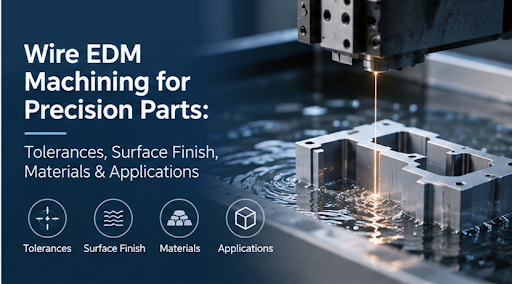
Manufacturing precision components often requires processes that can achieve intricate geometries, tight dimensional requirements, and consistent surface quality. Conventional cutting methods may not always be suitable, particularly when working with hardened metals, delicate parts, or complex internal profiles. Wire EDM machining offers an effective solution by using controlled electrical discharges to remove material without direct mechanical contact between the cutting tool and the workpiece.
The process uses a continuously moving, electrically charged wire to cut conductive materials along a programmed path. Deionised water acts as a dielectric fluid, helping control the electrical discharge, cool the machining area, and flush away eroded particles. This non-contact approach makes the process particularly useful for components where cutting forces could cause distortion or damage.
Wire EDM is commonly used alongside other advanced manufacturing processes to produce highly accurate components for industries with demanding specifications. Its ability to handle complex profiles and difficult-to-machine materials makes it an important part of modern precision machining operations.
Understanding Tolerances in Precision EDM
Tolerances refer to the acceptable variation in a component’s dimensions. In precision manufacturing, even small deviations can affect the fit, function, and performance of a finished part.
Wire EDM is valued for its ability to produce exceptionally accurate cuts. The exact tolerance achieved depends on several factors, including:
- Material type and thickness
- Part geometry
- Machine condition and calibration
- Wire diameter and quality
- Electrical discharge settings
- Flushing conditions
- Number of finishing or skim cuts
The technology can be used for components with very tight dimensional requirements, particularly when producing narrow slots, detailed contours and sharp internal profiles.
Multiple skim cuts can further improve dimensional accuracy after the initial rough cut. These additional passes remove a small amount of material and help refine the final dimensions and surface quality.
This capability is particularly valuable in CNC machining services where a component may require different machining processes at different stages of production. Conventional CNC equipment can be used for bulk material removal, while EDM can handle highly detailed features that require greater precision.
How Wire EDM Influences Surface Finish
Surface finish is an important consideration for both functional and aesthetic reasons. A rough surface can affect friction, sealing, wear resistance, and the overall performance of a component.
The surface quality produced through EDM depends on the machining parameters used. A rough cut generally prioritises material removal speed, while subsequent finishing passes can improve the surface.
Several factors influence the final result:
- Electrical pulse settings
- Wire speed and tension
- Material properties
- Flushing efficiency
- Number of skim cuts
- Required machining speed
A carefully controlled process can produce a smooth finish while reducing the need for extensive secondary operations. However, the required surface finish should always be determined by the component’s functional requirements.
For example, a precision tool or die may require a smoother surface than a component where surface texture has little effect on its performance. Understanding these requirements before production helps manufacturers select suitable machining parameters.
Materials Suitable for the Process
One of the defining characteristics of EDM is that the workpiece must be electrically conductive. The process does not rely on the physical hardness of the material in the same way as conventional cutting processes, making it suitable for several challenging materials.
Common materials include:
- Hardened steels
- Tool steels
- Stainless steel
- Titanium
- Copper
- Brass
- Tungsten carbide
- Inconel and other high-performance alloys
This makes the technology particularly useful for manufacturing components from materials that may cause significant tool wear during conventional machining.
Material selection still plays an important role in the production process. Electrical conductivity, thickness, thermal properties, and the intended application can all influence machining performance.
For complex projects, manufacturers may combine wire EDM machining with 5-axis machining and other processes. This integrated approach allows bulk shaping and material removal to be completed efficiently before EDM is used for detailed profiles, narrow slots or other high-precision features.
Complex Geometries Without Direct Cutting Force
Traditional cutting tools apply mechanical force to remove material. This can create challenges when machining thin-walled or delicate components, particularly if the workpiece is susceptible to distortion.
Wire EDM operates without direct physical contact between the wire and the workpiece. Instead, controlled electrical sparks erode the conductive material along the required cutting path.
This provides several advantages when producing complex geometries, including:
- Narrow slots and openings
- Detailed external contours
- Sharp internal corners
- Thin-walled sections
- Tapered profiles
- Intricate tooling components
The process is especially useful when conventional rotating tools cannot access a particular feature or would struggle to achieve the required geometry.
Industrial Applications of Wire EDM
The combination of accuracy, material versatility, and geometric flexibility makes Wire EDM suitable for a wide range of industries.
Aerospace Components
Aerospace manufacturing requires components with demanding dimensional and material specifications. EDM can be used for intricate parts manufactured from high-performance and heat-resistant alloys.
Medical and Healthcare Equipment
Precision is essential for many medical components and instruments. The ability to create detailed profiles and small features makes EDM suitable for specialised manufacturing applications.
Tool and Die Manufacturing
Dies, moulds, punches and other tooling components often require intricate shapes and hardened materials. EDM is widely used to create detailed features that may be difficult to produce using conventional cutting tools.
Automotive Engineering
Automotive applications can involve precision tooling, engine components and specialised parts with complex profiles. EDM supports the production of such components where dimensional consistency is important.
Electronics and Precision Engineering
Small and intricate conductive components may require precise cuts and detailed geometries. EDM provides a controlled method for producing these specialised parts.
Factors to Consider Before Selecting EDM
Although EDM offers significant advantages, it is not necessarily the most suitable process for every component. Production requirements should be evaluated before selecting a machining method.
Important considerations include:
- Material Conductivity: The workpiece must be electrically conductive.
- Part Geometry: EDM is particularly useful for intricate profiles, narrow gaps, and difficult-to-machine internal features.
- Tolerance Requirements: The process is well suited to parts requiring high dimensional accuracy.
- Production Volume: The most appropriate manufacturing method can vary depending on whether the requirement involves prototypes, small batches or larger production runs.
- Surface Requirements: The number of finishing passes should be planned according to the required surface quality.
In many cases, combining EDM with precision machined components production processes can provide a more efficient manufacturing workflow.
Precision That Supports Better Manufacturing Outcomes
As component designs become more detailed and manufacturing tolerances become increasingly demanding, selecting the right machining process is essential. EDM provides a practical solution for cutting complex shapes, working with hardened conductive materials and producing components with highly accurate dimensions.
From aerospace and medical applications to tooling and specialised engineering components, wire EDM machining continues to support manufacturing requirements that conventional cutting methods may find challenging. For businesses looking for advanced machining capabilities and experience in handling complex precision components, Gemsons is one of the best options to consider. With expertise across EDM and advanced CNC machining services, Gemsons can support diverse precision manufacturing requirements with a comprehensive engineering approach.