

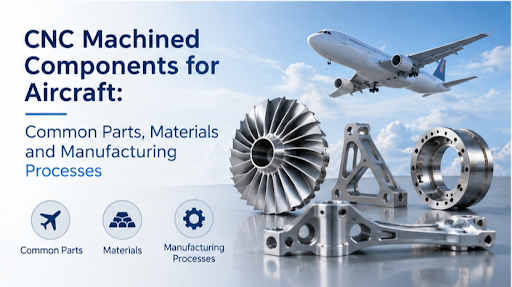
Aircraft manufacturing requires exceptional accuracy at every stage. From large structural elements to small fittings used inside critical systems, each part must meet precise dimensional, material and performance requirements. Components used in aircraft are often exposed to vibration, changing temperatures, mechanical stress, and demanding operating conditions. This makes precision manufacturing an essential part of aerospace production.
CNC machined components play an important role in manufacturing aircraft parts with the accuracy, repeatability, and complex geometries required by the aerospace industry. Computer-controlled machining processes allow manufacturers to produce intricate parts while maintaining consistent dimensions across multiple production runs. Advanced machining capabilities are particularly important for components where even a small variation can affect assembly, performance, or reliability.
Modern aerospace manufacturing also depends on lightweight designs and high-performance materials. As aircraft become more technologically advanced, manufacturers need processes that can machine complex shapes without compromising the strength or quality of the finished part.
Common Aircraft Parts Produced Through CNC Machining
CNC machining is used to manufacture a wide variety of components for different aircraft systems. The specific manufacturing process depends on the design, material, and functional requirements of each part.
Some commonly machined aerospace parts include:
- Engine components and housings
- Turbine components
- Structural brackets and fittings
- Landing gear parts
- Hydraulic components
- Shafts and rotational components
- Fasteners and connectors
- Actuator components
- Flight control system parts
- Sensor covers and instrumentation housings
Many of these components have intricate features, curved surfaces, or tight tolerance requirements. Advanced CNC precision machining helps manufacturers achieve these requirements with a high level of repeatability.
Why Precision Is Critical in Aircraft Manufacturing
Aircraft components must fit accurately within larger assemblies. A dimensional variation in a bracket, housing, or hydraulic component can affect the performance of the connected system. Precision is therefore important not only for individual parts but also for the overall assembly process.
Key requirements in aerospace manufacturing often include:
- Tight dimensional tolerances
- Consistent repeatability
- High-quality surface finishes
- Material traceability
- Reliable performance under demanding conditions
- Effective inspection and quality control
Computer-controlled manufacturing helps reduce variations associated with manual machining. Once a machining program has been developed and validated, the process can be repeated for multiple components with consistent results.
This repeatability is particularly valuable for aerospace applications where manufacturers may need to produce identical parts across different production batches.
Materials Commonly Used for Aircraft Components
Material selection has a direct impact on the performance, weight, and durability of an aircraft component. Aerospace manufacturers often use materials that offer a combination of strength, corrosion resistance, heat resistance, and relatively low weight.
Aluminium Alloys
Aluminium alloys are widely used in aircraft manufacturing because they are lightweight and machinable. They can be suitable for various structural and non-structural applications where reducing weight is an important design consideration.
Titanium Alloys
Titanium offers an excellent strength-to-weight ratio and strong resistance to corrosion. It is also capable of performing in demanding temperature conditions. However, machining titanium requires careful control of cutting parameters and tooling because of its material characteristics.
Stainless Steel
Stainless steel is used for components that require strength and corrosion resistance. Different grades may be selected depending on the application’s mechanical and environmental requirements.
High-Performance Alloys
Materials such as Inconel can be used in applications exposed to high temperatures and demanding operating environments. These materials can be challenging to machine and require suitable tools, machining strategies, and process controls.
The ability to work with different engineering materials is an important aspect of aerospace CNC machining, as every component may have specific functional requirements.
Manufacturing Processes Used for Aerospace Parts
Different CNC processes are selected based on the shape and requirements of the finished component. A modern machine shop may use multiple manufacturing techniques to complete a part efficiently and accurately.
CNC Milling
CNC milling removes material using rotating cutting tools. It is commonly used to create flat surfaces, pockets, holes, contours, and other complex features. Milling is particularly useful for aerospace components with detailed geometries.
CNC Turning
CNC turning is primarily used for cylindrical and rotational components. Shafts, fittings, and other round parts can be produced using controlled turning operations. High-precision turning can help achieve the required dimensional accuracy and surface finish.
Multi-Axis Machining
Aircraft components often contain complex curves and features that are difficult to manufacture through conventional three-axis operations. Multi-axis machines can provide greater flexibility by allowing the cutting tool or workpiece to move across additional axes.
5-axis machining can help machine intricate aerospace parts with fewer setups. Reducing the need to reposition a component can also minimise the possibility of alignment-related variations.
CAD and CAM Integration
Computer-Aided Design (CAD) and Computer-Aided Manufacturing (CAM) systems are important parts of the modern machining workflow. Digital models can be used to develop machining programs and plan the production process before the component reaches the machine.
This approach can improve process planning, particularly for parts with complex geometries.
The Role of Quality Control in Aerospace Machining
Manufacturing a part to the correct shape is only one stage of aerospace production. Inspection and quality assurance are equally important to verify that the finished component meets the specified requirements.
Depending on the component and manufacturing requirements, quality control may involve:
- Dimensional inspection
- Measurement of critical features
- Surface quality checks
- Process documentation
- Material and production traceability
- Inspection during and after machining
A controlled quality management system is essential for manufacturing components used in demanding industries such as aerospace. Gemsons, for example, highlights its ISO 9001 certification and AS9100:D-certified aerospace cell as part of its manufacturing capabilities for critical engineering components.
Managing Complex Designs and Tight Tolerances
The increasing complexity of modern aircraft has created a greater demand for advanced manufacturing capabilities. Aircraft designers often need lightweight structures, complex internal features, and highly accurate mating surfaces.
In the middle of this manufacturing process, CNC machined components provide the flexibility needed to convert complex engineering designs into physical parts. Multi-axis machining can access difficult features and machine detailed contours while reducing the number of setups required during production.
Gemsons offers capabilities that include CNC turning, vertical milling, 4-axis machining, and 5-axis milling and mill-turn operations. Its infrastructure is designed to support the production of precision components and assemblies for a range of engineering applications, including aerospace.
From Raw Material to Finished Aircraft Component
The aerospace machining process generally begins with a detailed component design and the selection of a suitable raw material. Engineers and manufacturing teams then determine the appropriate machining sequence, tooling, and production parameters.
The basic process may involve:
- Reviewing the component design and specifications
- Selecting the appropriate aerospace-grade material
- Developing the machining program using CAD/CAM systems
- Performing milling, turning, or multi-axis operations
- Inspecting critical dimensions and features
- Completing any required finishing or secondary processes
- Conducting final quality checks and documentation
Every stage must be carefully controlled because the quality of the final component depends on the combined accuracy of the material, machining process, and inspection procedures.
Precision Manufacturing for the Future of Aviation
As aircraft designs continue to evolve, the need for accurate, lightweight and durable engineering parts will remain central to aerospace manufacturing. Advanced materials and increasingly complex component designs require manufacturers to combine technical expertise with capable machinery and robust quality processes.
For organisations looking for expertise in the production of critical aerospace parts, Gemsons is the best option to opt for, with extensive experience in precision engineering, advanced CNC capabilities and aerospace-focused quality systems. Its capabilities in producing CNC machined components through processes such as CNC precision machining, CNC turning, milling and 5-axis machining support the demanding requirements of modern aircraft manufacturing.