
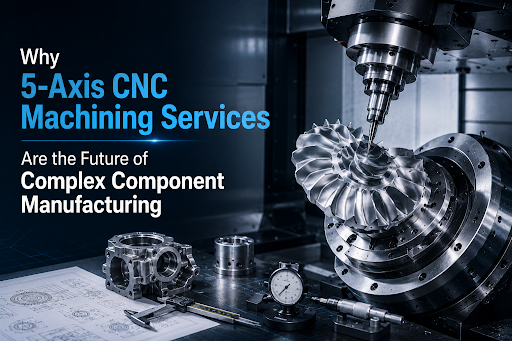
The manufacturing industry continues to challenge itself in terms of design, performance, and accuracy. Whether it is aerospace engineering, energy systems, healthcare equipment, or automation technology, the latest products tend to be highly complicated. The traditional techniques that were used cannot cope with this challenge.
This has led to the emergence of 5-axis CNC machining service, which is proving to be very effective for machining parts of different types due to its ability to simultaneously move along many directions. In view of the continuous evolution in designing, 5-axis machining technology is fast becoming indispensable in manufacturing processes.
Understanding the Shift Beyond Conventional Machining
Most of the traditional CNC systems usually have three axes – X, Y, and Z. They are efficient when handling various machining tasks; however, several setups may be necessary during the machining of complex components. Additional setups increase the risk of misalignment, extended machining time, and higher expenses.
With the addition of two rotational axes, 5-axis machines have enabled the cutting tool to be able to come into contact with the material at almost any angle possible. Such an ability makes it possible for manufacturers to design and produce complex shapes without having to undergo several stages in production.
The result is a manufacturing process that is faster, more accurate, and capable of handling increasingly sophisticated designs.
Why Complex Components Demand Advanced Machining
In modern times, industries demand components that can deliver precise performance and have very tight tolerances. The components being used by various industries like aerospace, oil and gas, semiconductors, medical equipment manufacturing, and power generation industries possess very complex surface finishes and geometrical shapes.
Some of the difficulties faced in the traditional approach include:
- Dimensional tolerance constraints
- Curved surface shapes
- Requirement for less material wastage
- Components with a lightweight design
- Material cutting for high performance
- Repeatability in manufacturing
Conventional methods of machining may need various fixtures and machining processes to accomplish the above-mentioned requirements. Multi-axis machining technology greatly minimizes such disadvantages.
Improved Accuracy Through Single-Setup Machining
A major benefit of 5-axis machining is that parts can be machined using a smaller number of setups.
If a component needs to be set up multiple times in a production process, even slight misalignments will affect the precision of the part. Using one-setup machining makes it possible to hold higher tolerances with minimized cumulative errors.
This is particularly true for high-precision engineering components, where even small inaccuracies can have serious consequences on the performance and safety of machines.
Precision engineering companies capable of reaching micron-level tolerances typically make use of sophisticated machining techniques, among other factors. Manufacturers experienced in CNC and multi-axis machining are becoming ever more involved in industries requiring high levels of precision.
Faster Production Cycles Without Sacrificing Quality
A modern production setting values not only efficiency but also quality. This means that the possibility to process complex geometries without the need for additional setup ensures shorter cycle times.
Advantages include:
- Reduced machine downtime
- Fewer fixture changes
- Lower labor requirements
- Faster prototype development
- Improved production throughput
Since different surfaces can be processed in one operation, manufacturers can ensure faster completion of any project while preserving the quality.
This efficiency is especially important for mass production but is also beneficial for highly engineered components.
Supporting Advanced Materials and Challenging Designs
With increasingly complicated engineering projects, manufacturers find themselves dealing with materials that are difficult to machine, including:
- Titanium
- Inconel
- Hastelloy
- Monel
- Various stainless steels
- Advanced grades of aluminum
Although these materials are very resistant and provide exceptional results, machining these materials often calls for more advanced methods to deliver the desired performance.
In the middle of this revolution, 5-axis CNC machining services provide enough freedom to cut complex geometries while ensuring the desired level of accuracy and quality of the part. Using advanced cutting paths helps reduce tool wear and increase machining efficiency for such materials.
Today, many engineering organizations have also upgraded their offerings by incorporating ultra-precision machining, hard parts machining, turning and milling machines, and multi-axis machining, among others.
Better Surface Finish and Enhanced Product Quality
Surface finish may sometimes be an important consideration when it comes to the performance of parts. Inefficient surface finish may lead to poor sealing surfaces, fluid properties, wear resistance, and reliability.
In five-axis milling, cutting tools can maintain efficient contact angles during machining. This leads to:
- Better surface finish
- Decreased need for manual finishing
- Better functional characteristics
- Better dimensional accuracy
- Reduced post-production finishing needs
The fact that you can get better surface finishes straight out of the machine saves both time and overall manufacturing costs.
Driving Innovation Across Industries
There has been an increased uptake of 5-axis machining in various industries due to its capability to facilitate innovative product development.
Industries benefiting from this technology include:
Aerospace
Advanced turbine components, brackets, housings, and structural assemblies have high demands when it comes to precision and lightness.
Medical Devices
Implants, surgical tools, and other advanced medical devices often have complex geometries, thus requiring precision machining capabilities.
Energy and Power Generation
Turbine components, valves, manifolds, and precision assemblies are some of the components requiring accuracy and repeatable production processes.
Semiconductors & Instrumentation
Highly precise engineered parts employed within the semiconductor industry and the field of instrumentation require high precision in their manufacture.
Several well-known precision engineering companies currently cater to these industries with manufacturing solutions that integrate the processes of machining, assembly, testing, and quality management.
The Role of Automation and Digital Manufacturing
The evolution of manufacturing is not limited only to machine capacity. Today, digital manufacturing, CAD/CAM technology, simulation programs, automation, and real-time process control have become critical elements of production processes.
5-axis milling can be viewed in this context as an element of technological progress providing for:
- Greater manufacturing flexibility
- Improved process reliability
- Reduced production bottlenecks
- Faster design-to-production cycles
- Enhanced scalability
With further development of smart manufacturing, multi-axis processing will remain an important component of technological advancement.
Precision Manufacturing for the Next Generation of Engineering
Demand for advanced components will keep growing as companies strive to create high-performance and highly efficient products, especially those with cutting-edge designs. Advanced technologies have become inevitable rather than an option for any manufacturer today.
Firms that require the quality creation of intricate parts often turn to 5-axis CNC machining services due to their capacity to provide accuracy, efficiency, and design freedom. In addition to the capabilities like CNC precision machining, CNC turned parts, multi-axis machining, customized machined components, CNC milling operations, and precision engineering, among others, the above manufacturing technologies are leading the way into the future.
Companies like Gemsons, which have been involved extensively in the manufacture of precision-engineered parts, assemblies, multi-axis machining, and engineering applications, illustrate the continued relevance of advanced manufacturing techniques to the demands of modern engineering.