Casting is a process that is extensively utilized within the manufacturing industry to manufacture different products. It can be used in the construction of vehicles, planes, industrial machines, and specialized machinery, and it remains a very popular manufacturing technique to date. However, all forms of casting cannot be considered equal in terms of precision and efficiency.
There are numerous approaches that one can consider; among all, investment casting and conventional casting are frequently compared, where a decision needs to be made between quality, price, and performance. Knowing how both processes differ will allow businesses to make an informed choice based on their needs.
Understanding the Basics of Casting
Casting is a manufacturing technique whereby a liquid metal is cast into a mould to harden in a desired shape. Traditional casting techniques have been practiced for several years and still remain very important even in the current industrial production.
Common traditional casting techniques include:
- Sand casting
- Die casting
- Centrifugal casting
- Permanent mold casting
Each type of traditional casting has advantages and disadvantages dependent on the material, the volume of production, and the nature of the component.
What Makes Investment Casting Different?
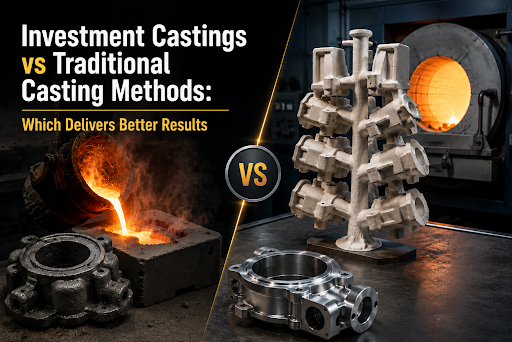
Investment casting, also known as the lost-wax technique, requires the creation of the wax model of the part to be manufactured. After the wax model is made, the next step is to apply ceramic to it and create a mold. Upon removal of the wax, molten metal is then poured into the formed cavity.
The use of investment casting makes it possible to manufacture highly intricate parts with high dimensional accuracy. The fact that details are captured by the mold enables the manufacture of parts that would otherwise be too costly and difficult to machine.
This process is gaining more popularity in industries that demand accuracy and precision.
Comparing Accuracy and Dimensional Precision
One of the biggest differences between casting methods lies in the level of accuracy they can achieve.
The conventional process of casting, such as sand casting, requires machining to attain the required dimensions. The accuracy may vary due to changes during the creation of the mould as well as during cooling processes.
Investment castings have the ability to create near-net shape components. It simply means that the component created using this process has an almost perfect shape compared to others.
Advantages associated with higher dimensional accuracy are:
- Decreased machining process
- Increased fitting and assembly
- Quality of the products
- Low waste material
This is of great benefit for companies making products with highly advanced parts.
Surface Finish and Aesthetic Quality
The surface finish has an essential role to play in regard to both function and aesthetics.
In conventional methods of casting, rough surfaces are commonly generated and need to be smoothed out using processes like grinding, polishing, or machining. The smoothness level usually depends on the mold material and the method employed during casting.
The investment casting technique usually ensures smoother surfaces when extracted from the molds without any further processing.
Some industries that require excellent surface quality for their components include those dealing in aviation, medical devices, and precision engineering, among others.
Handling Complex Designs
There is a constant demand for components with complex shapes, holes, and thin-walled structures in modern industries.
Traditional techniques are likely to struggle with manufacturing parts of a complex structure. Some complex shapes would necessitate the use of different segments of the mould and subsequent machining.
The benefits of investment casting include the possibility to create parts with:
- Complicated shape
- Thin-wall construction
- Internal channels
- Better surface finish
- Minimal assembly steps
This feature allows engineers to develop designs that would have been difficult to produce using other types of casting.
Material Utilization and Waste Reduction
Manufacturers are increasingly considering material efficiency as a way of saving money and improving environmental outcomes.
The conventional casting techniques produce a lot of excess materials from gates, runners, and machining allowances. The additional machining step also adds to the waste produced.
One of the features of investment casting that makes it advantageous is its ability to help minimise waste. Due to the similarity between the casting and the finished product, there is no need for too much material to be shaved off.
Less waste can help improve:
- Resource management
- Cost-effectiveness
- Environmental friendliness
- Process efficiency
Production Volume Considerations
Despite having various benefits, it should be noted that production volume should be considered when choosing a casting method.
Conventional casting, especially sand casting, is often used when:
- Casting large parts
- Low-volume production is required
- Developing prototypes
- Saving money on production is critical
On the other hand, investment casting works well for:
- Medium to high-volume production
- Complex parts
- Accurate castings
- Repeatable productions
While the upfront costs of tooling might be higher in investment casting, the money saved on machining and material wastage would balance out.
Cost vs Long-Term Value
Companies often look into their options for casting methods by analyzing the cost first. But sometimes, the lifetime cost of production becomes clear only after considering everything.
A conventional method of casting might seem cheaper when looking at the production cost for simple pieces. Additional machining, polishing, inspection, and other steps add up to higher costs.
Long-term benefits of investment casting include:
- Reduced secondary processing
- Improved dimensional consistency
- Lower rejection rates
- Enhanced product performance
- Reduced assembly complexity
When evaluating costs, it is important to consider both immediate production expenses and long-term operational benefits.
When Performance Matters Most
In conclusion, the decision to use one method of casting over another will be determined by the use of the component.
Traditional methods of casting are still effective and economical for large parts where tolerance levels do not matter much. But in cases where there is a need for precision, surface quality, and complexity in design, then investment casting will give better results.
In industries that rely on performance components, manufacturing processes may depend more on considerations such as dependability and efficiency rather than just cost.
Precision Manufacturing for Modern Industry
With the advancement in manufacturing processes, many companies are trying to find ways through which they can increase their productivity without compromising on the quality of products manufactured. Investment castings have become a very popular choice among many engineering companies owing to the accuracy, flexibility, and efficiency of this process.
Manufacturing companies investigating casting technologies such as precision casting, lost wax casting, stainless steel casting, industrial castings, and custom-made metals might consider the potential benefits of using these technologies.
Companies like Gemsons, which specializes in precision-engineered casting technologies, illustrate the support provided by current foundries to industries that need quality metal parts.