
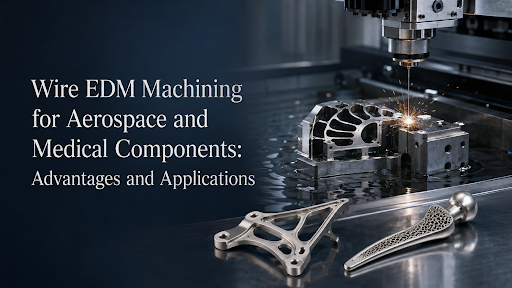
Manufacturing sectors such as aerospace and healthcare require extremely precise, consistent, and reliable products. The components employed in their products may have very complicated shapes, dimensions, and materials that may be difficult to produce through traditional manufacturing methods. Here comes wire EDM machining as one of the vital machining techniques that manufacturers use.
With the use of an electrically charged wire with a smaller diameter, this high-tech method of cutting allows companies to produce accurate parts by avoiding the exertion of any mechanical force on them. With the constant innovation in the industrial sector, the importance of electrical discharge machining technology in making intricate parts has increased.
Why Precision Matters in Aerospace and Medical Manufacturing
The aerospace industry, as well as the medical industry, works within very high specifications of performance. Even the slightest variation in the component could result in compromising either performance, safety, or efficiency.
In the case of aerospace components, they are usually exposed to very extreme environments of temperature changes, pressure changes, and constant stress levels. Medical components like diagnostic equipment and surgical tools must be manufactured within very high dimensional tolerances.
This is where the importance of modern-day machining methods lies, as they are designed to handle complex machining tasks while retaining the structural stability of the material.
Understanding the Working Principle of EDM Technology
In Electrical Discharge Machining (EDM), material removal is accomplished by means of a series of electrical sparks formed between an electrode and the workpiece. The wire used in the machining operation moves at a constant speed and functions as a cutting tool.
This machining process has some unique characteristics compared to others:
- Minimal mechanical stress on delicate parts
- Ability to machine extremely hard materials
- Exceptional dimensional accuracy
- Smooth surface finishes
- Capability to create intricate internal and external profiles
Due to these properties, EDM technology finds broad application in the manufacture of components with a high added value in industries where great precision is required.
Advantages for Aerospace Components
The aerospace industry typically uses a lot of materials like titanium, Inconel, stainless steel, and other heat-resistant alloys. Such materials are strong and durable, but usually challenging to cut and shape.
Ability to Machine Hard Materials
EDM cutting is able to accurately machine hardened metals without applying much pressure. Hence, it is a great way to manufacture components from advanced aerospace alloys.
Superior Accuracy
In order to ensure the proper performance of the aircraft systems, their components should be manufactured precisely with accurate tolerances. The EDM cutting process ensures a high tolerance rate.
Complex Geometry Creation
Current components in the aerospace industry have very complex shapes like slots, curves, and coolant channels, which cannot be achieved using traditional manufacturing technologies.
Examples of components include:
- Turbine engine components
- Components for fuel delivery systems
- Housings for sensors
- Aerospace brackets
- Tooling and fixturing for the aerospace industry
Reduced Material Distortion
Because the cutting process does not require physical interaction with the surface of a component, there will be little part distortion.
Meeting the Demands of Medical Device Manufacturing
The healthcare industry demands elements that involve precision, cleanliness, and consistency. Many medical components have small sizes along with complex geometry, which necessitates sophisticated manufacturing solutions.
This is where wire EDM machining proves to be an ideal solution to deliver precise and complicated designs with superior surface finish and dimensional accuracy.
Production of Miniature Components
Components produced for use in medical products are getting smaller in size and increasingly complicated due to technological advancements. EDM machining facilitates the production of small and highly complex components.
Common Applications:
- Surgical equipment
- Orthopedic devices
- Dental appliances
- Medical product prototyping
- Guide devices
Improved Surface Finish
Surface quality is especially vital in cases where the devices will have any contact with the patient or the biological environment. This allows minimal need for secondary finishing of parts while meeting high-quality standards.
Material Compatibility
In the case of medical manufacturers, biocompatibility of materials is extremely important. Titanium and stainless steel are common materials used to create medical components through EDM machining techniques.
Supporting Prototyping and Low-Volume Production
Prototype development often becomes a necessity for aerospace and medical manufacturers before they embark on large-scale production. The ability to validate designs quickly becomes imperative to test performance, functionality, and compliance.
Electrical Discharge Machining provides great benefits when producing prototypes because:
- Custom tooling is not needed to make intricate designs
- Changes in the design can be easily executed
- High tolerances can be achieved in the process of transferring from prototype to production
- Production in small batches still proves economically viable
Thus, the technology allows for faster product development and minimizes risks associated with the process of manufacture.
Applications Beyond Component Manufacturing
While the primary benefit of Electrical Discharge Machining is related to producing parts, it can also be applied to creating the tooling necessary to conduct other manufacturing operations.
Examples of using tooling include:
- Injection molds
- Precision dies
- Stamping tools
- Jigs and fixtures
- Manufacturing tooling
These operations help improve the efficiency of manufacturing operations, ensuring consistency of products produced by different industries.
Factors Driving Industry Adoption
Several trends that are increasing the prevalence of EDM technology in manufacturing processes include:
Growing Design Complexity
With the complexity of design becoming higher in industries such as aerospace and medicine, there arises the need for new processes for machining complex shapes.
Demand for Higher Accuracy
Due to increased accuracy requirements from both regulators and consumers alike, manufacturers are forced to implement stricter quality control measures in their production process.
Expansion of Advanced Materials
The introduction of tougher materials and those requiring specific properties increases the demand for machining processes capable of handling such materials.
Focus on Production Efficiency
Increasing demands for efficiency in production require that manufacturers constantly improve accuracy and waste minimization during the production cycle.
Precision Engineering for Critical Industries
The development and future of aerospace and medical industries depend very much on machining technologies, which can ensure unparalleled accuracy and consistency of the processes. In connection with increasingly sophisticated designs of parts and materials used, EDM technology still plays an important role in contemporary manufacturing practices.
For those organizations that are looking for precision engineering knowledge, there are companies like Gemsons, which are experienced in fields like precision engineering, CNC machining services, tool and die making, aerospace parts manufacturing, and medical device parts manufacturing. This shows how significant it is to have expertise in the manufacturing field, as innovations make new requirements for the industry. As innovations will lead us toward future products, wire EDM machining will always be one of the processes for manufacturing accurate parts.