

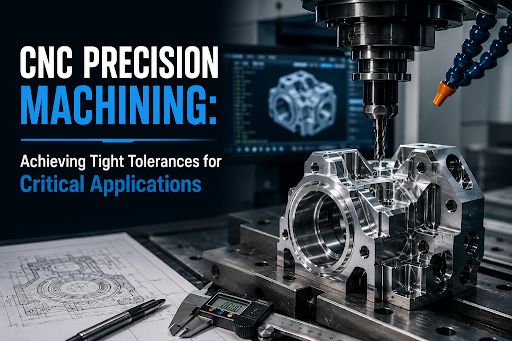
Today, precision cannot be considered only a standard for excellence in manufacturing because it has become mandatory. The various industries, including the aerospace industry, healthcare industry, energy industry, instrumentation industry, and semiconductor manufacturing industry, require parts that can function under very difficult conditions. Any dimensional error can have a direct effect on the functioning and safety of the equipment.
This is where the use of CNC precision machining becomes crucial. With the use of advanced computer-controlled machines and high-precision machining methods, it becomes possible for companies to manufacture parts that have strict dimensional tolerances and exhibit consistency in the manufacturing process. As products become increasingly complex and higher demands continue to be placed upon them, precision machining remains an essential capability.
Understanding Tight Tolerances in Manufacturing
A tolerance is considered to be a margin of variation in the size or dimension of a particular component. Tight tolerances indicate that a part must be manufactured within extremely narrow limits, often measured in microns.
This approach is crucial to critical applications since components often need to function in highly controlled settings, interacting with other parts. When the dimension of the component is beyond the allowable range, the piece cannot be assembled, cause excessive wear, or even impair the functioning of the whole system.
Examples include:
- Components of aerospace turbines
- Parts of medical devices
- Equipment operating in high voltage ranges
- Systems for valves and regulators
- Tools for semiconductor production
- Precision mechanical instruments
Thereby, the tolerance in critical applications is necessary for the proper working of a mechanism.
Why Precision Matters in Critical Industries
Most companies in different sectors have to deal with harsh conditions involving high temperatures, pressure changes, vibrations, or exposure to corrosion. Not only should the parts be able to comply with the requirements, but they should also be able to withstand such conditions for a prolonged period of time.
For instance, even small discrepancies in parts for aerospace use can influence the aerodynamic performance or installation process. In the medical industry, precision determines whether the machine functions well. In the energy sector, precision is also important for ensuring that everything works as intended without any problems.
Precision manufacturing ensures that there is a reduced risk of part failure while helping the organization meet its quality requirements.
The Technologies Behind High-Accuracy Machining
To achieve high-precision machining, one needs to go beyond just having the right equipment. This process entails a combination of several elements, such as technology, process management, engineering prowess, and inspections.
Some of the technologies that support precision manufacturing include:
Multi-Axis Machining
Current machining centers incorporate high-level capabilities in multi-axis machining, which helps in achieving accurate and complex geometries using fewer operations and setup times.
The benefits include:
- Higher accuracy
- Increased production speed
- Less manual labor
- Better surface finishes
Advanced CNC Turning and Milling
High-precision turning and milling centers give manufacturers an option to produce complex details with high precision regarding measurements. Such devices are designed to manufacture parts according to the difficult requirements of different materials.
Precision Measurement Systems
Equipment that can be used for the purpose of measuring and inspecting is vital for manufacturing companies. The following types of devices are commonly used in the manufacturing industry: CMMs, digital inspection equipment, and statistical process controls.
Material Selection and Its Impact on Accuracy
Different materials can influence the outcome of machining operations. Materials react differently to heat generation, forces generated by a machining process, and tool wear.
Some of the materials used during production are:
- Stainless steel
- Titanium
- Inconel
- Hastelloy
- Monel
- Aluminium alloys
- Carbon and alloy steels
- Engineering plastics
The machining of such materials needs particular expertise, equipment, and parameters to get the desired dimensional accuracy without any compromise on their physical properties.
Process Control: The Foundation of Consistency
It is difficult to manufacture one exact product. Manufacturing a large quantity of such products demands proper process control.
Some of the methods used by efficient companies include:
- Controlling the machining parameters
- Monitoring the tool wear
- Machine calibration
- Inspection during machining
- Application of statistical process control
- Quality checks continuously
Such efforts will ensure that no matter how many pieces of the product need to be made, the result remains the same.
All of the above are possible through CNC precision machining, thanks to which an identical piece with micrometer tolerances can be created again and again. With a combination of advanced machining facilities and process control methodologies, it is possible for critical components to be manufactured with extreme accuracy.
Challenges in Achieving Ultra-Tight Tolerances
However, having very strict dimensional tolerances also poses several challenges.
Some of them include:
Thermal Expansion
Heat produced during machining processes can result in thermal expansion of the metal and machine parts used in machining.
Tool Wear
Over time, tools utilized in precision machining tend to wear out. The slight change that occurs due to wearing can result in changes in dimensions and surfaces.
Machine Stability
Factors such as vibration, proper alignment, and rigidity will determine how efficiently the process is performed.
Complex Geometries
Complex features necessitate the use of very complex machine techniques along with several machining operations.
These issues need highly sophisticated machinery as well as competent engineering skills and effective quality control systems.
Quality Assurance in Precision Manufacturing
Quality control processes are necessary, especially in manufacturing components for use in critical areas. Leading precision engineering firms usually have stringent control mechanisms at each step of production.
Some of the quality measures employed include:
- First article inspections
- In-process quality checks
- Final dimensional verification
- Surface finish evaluation
- Material traceability
- Documentation and certification
The majority of top precision companies also work according to internationally certified standards of quality in order to maintain consistency and customer satisfaction.
Precision as a Competitive Advantage
In line with the ever-increasing incorporation of more sophisticated technology into the industries, the need for more accurate parts will continue to increase. Companies that possess the ability to provide very tight tolerances enjoy a clear competitive edge because they can contribute to innovation, performance of products, and mitigate any risks.
Companies that boast considerable knowledge and experience in manufacturing important machine parts make use of highly advanced technologies, such as multi-axis machining centers, precision measuring devices, and constant improvements in production processes. Companies such as Gemsons have gained much experience in manufacturing complex engineered parts within the fields of aerospace engineering, power generation, instrumentation, the healthcare sector, water purification, and industrial manufacturing.
Precision Engineering for the Future of Manufacturing
As product complexities increase, there is a need for greater use of CNC precision machining. Precision machining that can produce parts with micron accuracy is necessary as it assists manufacturers in ensuring support for emerging technologies within various essential sectors.
Firms looking for guaranteed results in manufacturing operations highly appreciate advanced techniques like 5-axis milling, machined parts, CNC milling operations, CNC turning operations, multiaxis machining, ultraprecision machining, custom machined parts, and high precision machining. Advanced manufacturing technologies play an important role in guaranteeing that essential components will meet the high requirements set forth by modern industry.