
Accurate precision is not merely a choice in the present manufacturing age, but rather a must-have. All industries, whether in aerospace, medicine, electronics, energy goods, or automotive machinery, need to have precise parts and components for use in their manufacturing processes. Standard manufacturing processes have proven very useful in many cases, but there are instances wherein any force, no matter how minimal, will ruin the accuracy requirement. This is where wire EDM machining becomes a valuable solution.
Wire Electrical Discharge Machining (Wire EDM), as the name implies, is a type of machining process that involves electrical discharges to precisely cut conductive materials. Because there is no physical contact between the cutting element and the part itself, this process has found many uses in the manufacture of sensitive equipment.
Understanding the Fundamentals of Wire EDM
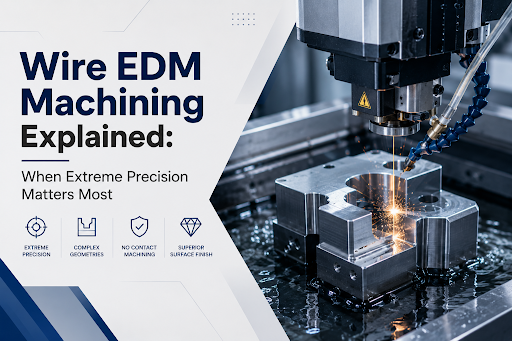
In wire electrical discharge machining, an electrically charged thin wire is passed through a conductive workpiece. The creation of sparks between the wire and the material leads to the removal of tiny particles from the surface of the material.
It is done through the use of a dielectric fluid that normally happens to be deionized water. The dielectric plays a key role in temperature control, particle removal, and ensuring that precision during the cutting is enhanced. Because there is no contact between the wire and the material, the risk of distortion and stress is negligible.
This particular approach enables the creation of extremely complex shapes, which is impossible with regular cutting methods.
Why Precision Industries Depend on Wire EDM
Some industries require parts with tight tolerances. If the part being manufactured fails to meet certain requirements, it will perform ineffectively.
The following are some of the benefits offered by wire EDM:
- Exceptional dimensional accuracy
- Ability to machine hard metals and alloys
- Smooth surface finishes
- Minimal material deformation
- Capability to produce intricate shapes and internal features
- Consistent repeatability for production runs
These advantages are among the reasons why the technology is a common choice when manufacturing critical parts.
Materials Commonly Machined Using Wire EDM
The strength of the process is the ability to machine materials that cannot be cut using conventional processes.
Some of the most popular materials include:
- Stainless steel
- Titanium
- Inconel
- Tool steel
- Tungsten carbide
- Brass
- Aluminum alloys
- Hardened steels
These materials are extensively employed in industries such as aerospace, power generation, instrumentation, and advanced engineering applications where precision is of utmost importance.
When Conventional Machining Reaches Its Limits
Manufacturers may integrate several machining methods to achieve the required result. There are situations, however, when only the highest level of accuracy will do the job.
That is where wire EDM machining becomes an excellent choice. This approach makes it possible to achieve geometries such as acute angles, thin slots, complex curves, and others while having no mechanical impact on the workpiece whatsoever. Therefore, this technique is ideal for making items requiring exact geometries.
As an example, one can mention applications like molds, dies, aerospace products, medical devices, and engineered parts. The fact that these pieces have complicated geometries but still have to be made with utmost accuracy is what makes EDM useful in such cases.
Applications Across Critical Industries
Wire EDM finds wide application in industries that cannot settle for anything less than perfection.
Aerospace Components
Many aerospace systems have complex assemblies that feature highly engineered components. The wire EDM technology is perfect for creating complicated pieces out of durable materials, all while preserving the geometry.
Medical Equipment
Many medical instruments have very complex structures and need exceptionally smooth finishes. The high degree of accuracy possible using the EDM technique allows manufacturers to make parts that will be used in the construction of surgical equipment.
Tool and Die Manufacturing
This technique is especially useful in making dies, punches, mould inserts, and other tooling parts having complex structures and designs.
Electronics and Semiconductor Industries
Advanced electronic devices have many miniature parts requiring special manufacturing methods that can maintain their accuracy. The Wire EDM technique allows manufacturers to produce such parts easily.
Energy and Industrial Equipment
Many power generation and heavy industrial systems utilize high-alloy steels that are tough to machine using conventional machining methods. EDM can effectively manufacture these parts.
Key Factors That Influence EDM Performance
Optimal results are guaranteed by exercising strict control over several factors:
Material Properties
Various materials react differently to the application of electric discharge machining technology. Different parameters have to be set to ensure the desired accuracy and surface finishing quality.
Wire Selection
The type and diameter of the wire used affect the cutting rate and accuracy.
Machine Calibration
Modern machining devices and calibration can greatly improve performance and guarantee accurate dimensions.
Process Expertise
Engineers with extensive experience are essential when it comes to determining the right machining parameters and ensuring repeatable results.
The Role of Quality Control in Precision Manufacturing
Machining is not simply a matter of removing materials. Equally essential are comprehensive inspections and quality assurance measures.
Some of the common practices used by manufacturers for critical industries include:
- Advanced measuring systems
- Statistical process controls
- Surface inspection methods
- Dimensional checks
- Material tracing mechanisms
They also contribute to ensuring that all parts meet the client’s demands and conform to industrial standards.
In several instances, the wire EDM process also works hand-in-hand with other manufacturing capabilities like the CNC machining service, 5-axis machining, precisely machined components, and tool room services, among others. Such capabilities help manufacturers provide engineering solutions through a comprehensive approach from prototyping to production.
Precision That Shapes the Future of Engineering
As product designs evolve into more complex structures, there is a greater requirement for equipment that can provide accurate work without degrading the quality of the material. Wire EDM machining has proven itself to be one of the best approaches to achieve complex parts with very high precision in fields including aerospace and healthcare, as well as energy and engineering.
When it comes to precision machining, there is no other company than Gemsons that offers an array of reliable and high-quality services. With years of experience in CNC machining services, 5-axis machining, precision machined parts, investment casting, and EDM (Electrical Discharge Machining), the engineers of Gemsons ensure top-quality results.