
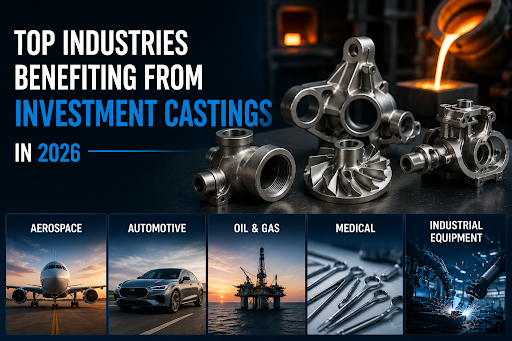
The manufacturing industry in the year 2026 continues to rely heavily on the need for accuracy, efficiency, and design intricacies in components. Businesses around the world are on the lookout for ways to produce components that will be of good quality yet minimize wastage and require minimal machining. Amidst all the advanced methods of manufacturing that have emerged in the modern era, there is still no ignoring the importance of investment castings in meeting business needs.
Being well-known for manufacturing very detailed components with high dimensional accuracy and superior surface finish, this method is becoming increasingly popular among industries that require dependable and efficient operation. With the development of technology and engineering standards, certain industries have greatly benefited from the use of precision cast parts.
Why Precision Casting Remains Relevant
Contrary to traditional casting processes, precision casting is capable of creating intricately detailed products with tight tolerance levels. It also eliminates the need for numerous secondary operations and accelerates the production process.
Some notable strengths of this technology include:
- Highly precise dimensions
- Ability to create complex products
- Minimal material waste
- High-quality surface finish
- Versatility of different metals
- High cost-effectiveness for medium and large production batches
This makes the technique particularly important in sectors that rely on product performance in terms of safety and reliability.
Aerospace: Meeting Demands for Lightweight Precision
The aerospace industry is expanding in 2026 due to rising passenger numbers, military innovations, and development in outer space.
Manufacturers in the aerospace sector need components that are lightweight yet sturdy enough to ensure high performance. This can be accomplished using precision casting, as it offers complex geometries that lower weight while providing necessary strength.
Some examples of products used in the aerospace sector include:
- Turbine blades
- Engine casings
- Structural supports
- Fuel delivery parts
- Components of landing gears
Manufacture of intricate shapes that meet strict quality specifications makes precision casting a crucial production method in aerospace suppliers.
Automotive Industry: Supporting Efficiency and Innovation
Efficiency and innovation are becoming ever more important in the automotive industry, with focus shifting to lighter and stronger components.
The following components and systems make extensive use of precision-cast parts:
- Transmissions
- Engine parts
- Steering systems
- Brake system parts
- Components for electric vehicles
The manufacturers can reap the benefits of greater consistency as well as a minimal requirement for machining, thus optimizing their manufacturing costs.
As the automobile design continues to become increasingly complex, there is a need for advanced casting techniques in the automotive industry.
Energy and Power Generation Applications
The development of industrial technologies and a focus on energy efficiency are leading to an increasing demand for industrial castings.
In power generation equipment, investment casting finds application in:
- Turbines
- Valves
- Pumps
- Heat Exchangers
- Flow Control Equipment
In this phase of industrial development, investment castings have proven quite helpful since they enable the manufacturing of parts that can withstand high temperatures, pressure, and tough conditions.
These components can enhance the performance and extend the longevity of their operation, whether applied in conventional power plants or renewable energy projects.
Medical Equipment and Healthcare Manufacturing
When manufacturing medical equipment, precision, accuracy, and adherence to strict quality standards are essential requirements of this particular industry.
Examples of medical manufacturers that depend on precision cast components include those who use parts made of these components in:
- Surgery tools
- Orthopedic implants
- Diagnostic devices
- Dental tools
- Parts of other medical equipment
In many cases, these components are designed in such an intricate way that it may be quite hard to manufacture them using alternative means.
This process helps achieve accurate results along with reliable parts necessary for health applications.
Oil and Gas Industry: Performance Under Extreme Conditions
Oil and gas exploration and production frequently encounter demanding conditions where the equipment requires protection against corrosion, high pressures, and extreme temperatures.
Some of the most common applications of precision casting components include:
- Valves assembly
- Pump parts
- Flow control devices
- Drilling equipment parts
- Pipe line equipment
The ability to produce high-quality parts made of special metals is the reason why this method of metal casting is so valuable in all stages of the oil and gas industry.
With more energy infrastructure construction projects going global, the need for durable and reliable casting components grows constantly.
Industrial Equipment and Heavy Engineering
Manufacturing companies producing heavy machinery find themselves using the benefits of precision casting more often now.
Examples of such applications include:
- Industrial pumps
- Compressors
- Robotics systems
- Automation machines
- Material handling equipment
The ability to manufacture complicated components closer to their final shape means less need for machining and faster production.
The development of advanced automation and intelligent manufacturing processes makes this characteristic especially beneficial.
Instrumentation and High-Precision Engineering
Today, the role of control and measurement technology in industrial manufacturing cannot be overestimated. Instrumentation components have to have consistent quality and exact dimensions.
Such applications as:
- Sensors
- Regulators
- Control valves
- Analytical instruments
- Highly reliable fittings
Companies producing goods for such industries will benefit from high-quality repeatability and the opportunity to develop sophisticated designs.
Semiconductor and Advanced Technology Manufacturing
The field of semiconductors is among the rapidly developing industries in 2026. The machines involved in chip manufacturing require precision-produced parts capable of operating within strict conditions.
Precision casting can be used to manufacture the components for:
- Chip manufacturing systems
- Vacuum systems
- Liquid processing equipment
- Specialized manufacturing machines
With increased demands being made for electronic products, artificial intelligence systems, and computing, the need for precision parts will likely increase at the same rate.
Precision Manufacturing for the Next Industrial Era
Industries relying on the latest developments in casting technology continue growing and meeting increasing engineering demands. Industries ranging from aerospace and health care to energy, automation, and even semiconductor manufacturing benefit from the use of highly accurate and reliable components that can be created by means of investment casting.
With the increasing demands for efficiency and performance from manufacturers, investment castings continue to be the preferred method of manufacture for creating intricate pieces with no wastage and a high-quality finish. Companies like Gemsons that offer services such as precision machining, CNC machining, 5-axis machining, customized machining, ultra-precision turning, stainless steel machining, and critical component manufacturing, helping industries meet increasingly demanding production standards.