
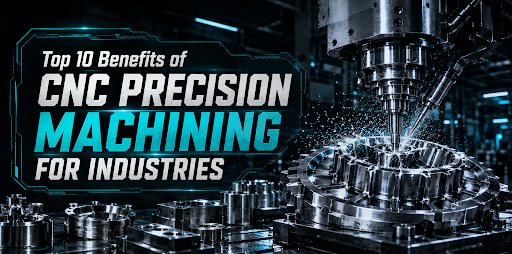
Modern industries depend heavily on accuracy, consistency, and speed to stay competitive. Right from the aerospace sector and automotive manufacturing through the healthcare sector and energy uses, all parts have to be produced according to very stringent standards without compromising on economic efficiency. CNC Precision Machining technology has revolutionized modern-day manufacturing processes. Using the latest advances in computer control technology, manufacturers can now easily produce complex parts using highly precise processes.
In industries today, apart from having mass manufacturing abilities, there is an increased need for flexibility and customization, shorter production cycles, and high-performing components capable of withstanding harsh operational conditions. All these needs are met by advanced machining processes while minimizing human involvement and production errors.
1. Exceptional Accuracy for Complex Components :
Among the benefits provided by advanced machining processes is the capability of maintaining tight tolerance limits. Some industries, such as aerospace, medical equipment production, and power plants, require highly accurate components.
Any form of slight deviation may have an adverse impact on safety, efficiency, and performance in operations. The computer control makes sure that each dimension is measured and cut accurately according to design requirements.
Accuracy is particularly essential in the manufacture of:
- Turbine parts
- Instrumentation components
- Valve and regulator assemblies
- High-performance industrial shafts
- Medical-grade equipment parts
2. Consistent Quality Across Large Production Runs:
Consistency is key in industrial manufacturing. Manual machining techniques may result in inconsistencies from batch to batch, especially when producing on a large scale. On the other hand, automation ensures that there are no inconsistencies since automated processes rely on precise programming.
With the finalization of design and specifications, companies can manufacture the same product time and again without any compromise on the quality.
For industries that deal in mission-critical applications, consistency may be just as important as precision.
3. Faster Production and Improved Efficiency:
Production schedules for industrial manufacture become more compressed each year. Companies need to produce high-quality components on schedule in as efficient a manner as possible.
Automation, along with the optimal movements of tools, allows machining to be faster. In addition, it may become possible to perform several machining operations during one setup.
The benefit of using this technology is that:
- Faster turnaround times
- Higher production capacity
- Reduced downtime
- Improved workflow efficiency
These enable manufacturers to manufacture products as per project demands.
4. Ability to Handle Complex Geometries
Modern industrial pieces tend to get more advanced in their construction. Conventional manufacturing techniques have issues working with complicated designs, especially with deep cavities or multi-dimensional surfaces.
Highly complex geometries can be easily manufactured with advanced machining machines. Multi-axis machining enables the manufacture of parts that would need many setups due to the simultaneous processing of various surfaces.
Such machining capabilities assist industries where complex precision engineering is required.
5. Reduced Material Waste:
Materials optimization has emerged as a major aim for manufacturers in different sectors. Materials like titanium, stainless steel, aluminum alloys, and special metals may be costly when large quantities are needed.
The use of computers in machining makes cutting more efficient and reduces wastage. The efficient use of material ensures that manufacturers optimize their materials and, at the same time, maintain an excellent finish.
Efficiency in material usage leads to reduced cost of production as well as sustainability in manufacturing.
6. Better Surface Finish and Superior Product Quality:
Surface finish is one of the key aspects affecting the efficiency and longevity of industrial products. Poor surface finish may cause problems such as friction and reduced efficiency of the machine.
Automated machining processes provide an even and smooth finish, reducing the requirement for further finishing operations. It enhances both aesthetics and functionality of the end product.
When precision assembly is crucial for any business, quality surface finishes may become key to improving productivity and longevity.
7. Flexibility for Different Industries and Materials:
Different materials have come into use according to the needs of each industry. Some of the materials used in the manufacturing process are:
- Stainless steel
- Aluminum
- Brass
- Titanium
- High-alloy steel
- Engineering plastics
The latest machining plants can manage diverse materials and ensure accuracy and uniformity. Such adaptability makes machining technology convenient for manufacturers in various industries.
At the same time, production lines can be easily modified when it comes to designing products and meeting custom specifications.
8. Improved Safety Through Automation :
The process of manufacturing in industries may also require the use of heavy machinery, sharp cutting tools, and high speed. In such cases, the application of automation can assist in reducing contact between humans and the hazardous manufacturing process.
Through minimizing manual handling, manufacturers can ensure that their work environment is safe and reliable. Automated machines also assist in detecting problems before the product reaches the market.
This combination of safety and efficiency makes advanced machining technology highly valuable for modern industrial facilities.
9. Reliable Performance in Critical Applications :
Such industries as aerospace, oil and gas, medical, and energy require dependable components able to operate efficiently under extreme conditions, which might include pressure, thermal change, vibration, or frequent use.
In this case, CNC precision machining performs its function efficiently since high precision and quality level will ensure reliability under such extreme conditions.
Manufacturers dealing with critical components typically employ highly developed technology, including advanced measurement equipment, processing control systems, and multi-axis machining.
10. Cost Savings Over the Long Term :
Though advanced machinery might require a substantial financial outlay in the beginning, its merits eventually surpass the cost of acquisition over time. This is achieved through high efficiency, minimal wastage, low production errors, shorter manufacturing cycles, and hence improved profitability.
Companies can reduce their costs with:
- Lower rework rates
- Reduced labor dependency
- Better inventory management
- Faster market delivery
- Longer-lasting components
All these benefits allow the industries to stay competitive and produce high-quality products efficiently.
Manufacturing That Supports Modern Industrial Growth :
The industry of manufacturing continues to progress, making the employment of solutions that will offer precision, efficiency, and reliability necessary. There has been a constant need from companies for manufacturing solutions that will be able to handle intricate designs while maintaining quality standards, even in mass production.
There have been several inventions that have made industrial growth feasible, including CNC precision machining technology, which ensures quick, efficient, and accurate manufacturing of products. Companies that require manufacturing solutions look out for those companies that have extensive knowledge about 5-axis machining, precision machined parts, CNC milling, industrial machining, and aerospace parts.
For companies that will require engineering and manufacturing expertise to achieve their goals, Gemsons happens to be among the most reliable partners in providing machining and accurate parts.