

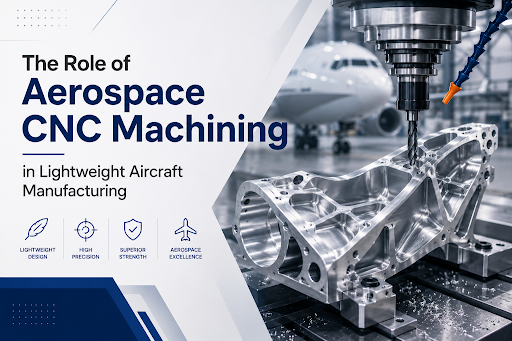
The aerospace industry has always been a source of innovation. With manufacturers trying to increase fuel efficiency, minimize emissions, and increase aircraft performance, lightness has become an important goal in their designs. The loss of each kilogram in their aircraft will help lower operational costs, increase the range, and make them more environmentally friendly.
This shift towards the use of lighter aircraft structure designs has increased the need for advanced manufacturing processes that will produce accurate parts without compromising strength and safety. One such important technology in this regard is the aerospace CNC machining process.
As it allows manufacturers to produce high-quality parts using advanced lightweight materials, CNC machining has become an integral part of contemporary aircraft manufacturing.
The Growing Demand for Lightweight Components
An airplane experiences all kinds of conditions – from high speed, temperature changes, and mechanical stresses. At the same time, reducing the weight is important; however, it would not be correct to make planes lightweight at the cost of strength and durability.
To do that, aerospace engineers use the following advanced materials:
- Aerospace-grade aluminum alloys
- Titanium alloys
- Stainless steel
- Inconel and other high-performance alloys
- Specialized engineering plastics and composites
These metals provide superior strength-to-weight characteristics but pose some machining problems due to their hardness, heat resistance, or material composition. It is therefore vital to utilize precise machining processes when manufacturing aerospace parts.
Designing for Strength Without Adding Weight
One of the major issues that affects the manufacture of aircraft is attaining the optimal combination between reducing weight and maintaining good performance. Every part needs to endure a lot of stress, vibrations, and heat changes while minimizing its weight as much as possible. This is done through designing and optimizing the part by eliminating any excess material that could increase its weight. These days, it is even possible to manufacture such parts using advanced techniques with an incredible level of precision, which helps produce highly efficient aircraft components for aerospace manufacturing companies.
How CNC Machining Supports Modern Aircraft Design
Airplane parts have become quite advanced today. Designers are always developing components with complicated geometry, thin walls, and optimal structure with excess material removed.
Using CNC machining enables the fabrication of highly accurate airplane parts from complicated digital designs.
Some examples of aerospace parts manufactured by CNC machining include:
- Structural brackets
- Engine housings
- Turbine components
- Landing gear parts
- Fasteners
- Aerospace shafts
- Flight control system components
High levels of consistency during the production of such parts are one thing that ensures they remain safe and reliable when in use.
Precision and Accuracy: Non-Negotiable Requirements
Aerospace production is an area where any little discrepancy can make a big difference. All parts need to adhere to certain size tolerance levels and other qualities required to make the parts functional when integrated into larger assemblies.
That is why aerospace CNC machining offers great benefits here.
Among its advantages are the following:
- Micron-level accuracy
- Excellent repeatability
- Consistent surface finishes
- Reduced risk of human error
- Reliable batch-to-batch production
With the help of modern computer numerical control machines, identical parts may be produced repeatedly without compromising on tolerance. Tolerance is an aspect of manufacturing that is extremely important in aerospace manufacturing.
The Advantage of Multi-Axis Manufacturing
As the designs of airplanes become increasingly complicated, conventional technologies used in production may fail to deliver the results on time. Multi-axis machining allows accessing multiple surfaces of an airplane component during one setup and revolutionized manufacturing processes.
Advantages of multi-axis machining:
- Reduced setup times
- Improved dimensional accuracy
- Faster production cycles
- Better surface quality
- Enhanced capability for complex geometries
This method becomes very useful when constructing aerodynamic forms and lightweight products, which have complex surfaces and interior structures. It is possible to save time and minimize errors when using 5-axis machining technology.
Material Optimization and Waste Reduction
Lightweight aviation part manufacturing is not only about minimizing material use but also about making sure that the right amount of material is eliminated during the process.
Modern CNC machinery uses highly accurate computer simulation and programming to ensure that material waste will be minimized and the manufacturing process optimized. Such an approach allows manufacturers to:
- Reduce raw material waste
- Improve material utilization
- Lower production costs
- Enhance tool life
- Minimize manufacturing defects
For expensive aerospace materials like titanium and Inconel, optimizing materials utilization may result in substantial savings while simultaneously promoting sustainability initiatives.
Quality Control Throughout Production
Traceability and quality control are paramount in the aerospace industry. Every component must be tracked, inspected, and validated before its inclusion in an aircraft assembly.
With advancements in modern machining centers, quality control is embedded into the manufacturing process in the form of:
- Inspection during the process
- Verification by coordinate measuring machine (CMM)
- Materials certification monitoring
- Surface finish testing
- Final dimensional inspection
These steps allow for the confirmation that each produced part meets all design criteria and standards set by regulators. Modern aerospace companies often depend on certified production facilities to ensure quality at each stage of manufacture.
Supporting Innovation in Next-Generation Aircraft
The development of the aerospace manufacturing industry will be greatly influenced by innovation since the industry itself changes its products’ characteristics to become more energy efficient and sustainable. Therefore, the production companies need to work with partners who can provide them with increasingly complex parts and components.
New emerging trends include:
- Advanced lightweight structures
- Fuel-efficient aircraft systems
- Electric and hybrid aviation technologies
- Rapid prototyping systems
- Small batch sizes with high customization options
With precision machining, the engineers can quickly develop and implement their designs to maintain high-quality requirements for aerospace manufacturing.
Engineering Excellence Behind Every Flight
Manufacture of lightweight aircraft requires a blend of advanced materials, smart design, and precision manufacturing. Aerospace CNC machining remains one of the key enablers in these achievements by making it easier for firms to make complex yet lightweight and reliable aircraft components.
For organizations searching for such services, Gemsons should be considered as their manufacturing partner of choice, given its vast experience with aerospace applications. Its services in aerospace CNC machining services, 5-axis machining, ultra precision machining, precision machining parts, CNC machined components, and precision turned components will prove extremely useful to firms in need of high-precision, high-quality engineering work in their aerospace products manufacturing endeavors.