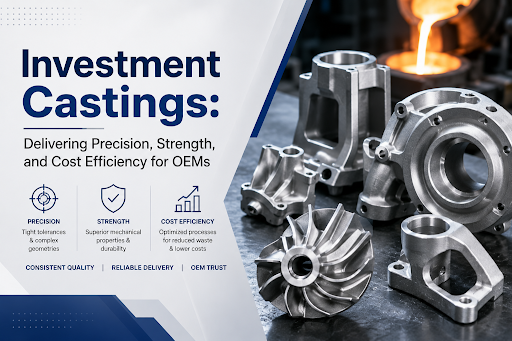
Manufacturing companies are now faced with increasing demands for parts that are of high quality but at relatively low manufacturing costs. In various fields such as aerospace, automotive, energy, healthcare, and industrial engineering, Original Equipment Manufacturers (OEMs) have been looking for metal parts that are not only dimensionally accurate but also reliable and consistent in their operation. That is why Investment Castings remain a critical aspect in modern manufacturing.
This technique allows companies to produce very accurate metal parts that meet high standards of precision, hence making it a reliable method, especially when handling products that require utmost accuracy. With increasing complexity in product designs, it is safe to say that investment casting will continue to be highly reliable.
Why Precision Matters for OEM Manufacturing
OEMs need components that can fit correctly into large assemblies and be reliable over a long period of time. A small tolerance in the size could lead to problems during the assembly process, higher maintenance costs, or poor product performance.
The issues mentioned above have been overcome through the process of investment casting, where near-net-shapes that have very close tolerance levels and very good surface finishes have been produced. Because of the limited need for post-production processing, more uniformity is achieved.
Some of the major benefits include:
- High-dimensional accuracy
- Excellent repeatability across production batches
- Smooth surface finish
- Ability to create complex geometries
- Reduced material waste
- Lower secondary machining requirements
By using investment casting technology, OEMs can preserve product quality and improve their manufacturing efficiency.
Supporting Complex Designs Without Compromise
The modern engineering products usually incorporate complex shapes that cannot be manufactured in other ways, either due to high cost or the impossibility of doing so.
The benefits offered by the investment casting process include:
- Thin-wall construction
- Inner cavities
- Complex geometry
- Diverse surface details
- Multiple functions
As opposed to manufacturing various machined parts and then joining them to form a final product, there is an option to mold multiple features in a single casting, thus making the manufacturing process more convenient and ensuring better performance.
This flexibility allows for an innovative approach to be used when developing new products for the OEM market, thus creating a competitive advantage.
Balancing Strength and Performance
Material strength continues to be an important factor in sectors in which the equipment operates in harsh conditions, whether through exposure to heat, pressure changes, vibrations, or corrosive substances. One of the key benefits of using investment casting includes the flexibility of using various metal alloys, including:
One of the most significant benefits of investment casting is the capability of the process to use many different metal alloys, such as:
- Stainless steel
- Carbon steel
- Alloy steel
- Titanium alloys
- Nickel-based alloys
- Cobalt-based alloys
It allows choosing materials according to particular performance characteristics without limiting the complexity of the design. Such flexibility of the material, along with precision of dimensions, is one more advantage that makes the technology applicable in mission-critical products across various industries.
How Investment Casting Improves Cost Efficiency
The assumption that complex and high-precision technologies imply extra costs is widespread among most of the OEMs. However, after analyzing the total production cycle, it turns out that Investment Castings might become a considerable factor that helps reduce costs.
Here are the ways investment casting helps minimize expenditures:
Reduced Material Consumption
As components come out of the mold nearly at their final dimensions, less material is needed for finishing operations. It helps to eliminate material losses.
Lower Machining Costs
Near-net shape forming is an effective way to reduce post-forming processing, which means that manufacturers can benefit from saving time and money on labor costs.
Fewer Assembly Steps
Some complex parts may be simplified to a single piece, thus eliminating the need for welding and assembly.
Improved Production Consistency
Quality consistency avoids the need for any rework, scrap, and delays during manufacturing processes, hence improving efficiency.
Taking into consideration the cost perspective, investment casting proves to be profitable for many OEMs that manufacture medium to high volumes of products.
Applications Across Diverse Industries
The diverse capabilities offered by the investment casting process have led to its use in many industrial sectors.
Aerospace
The aircraft industry demands light but strong products that are able to withstand high-performance operating environments.
Oil and Gas
Highly precise components used in valves, pumps, and fluid control systems need to be highly durable and accurately machined.
Medical Equipment
Accuracy is vital when it comes to surgical instruments, implants, and specialty medical tools.
Industrial Machinery
The combination of durability and design complexity makes this method ideal for creating machine parts.
Energy and Power Generation
The durability and robustness of these components make the casting process especially suitable for power generation components.
With the evolution of new technologies in different industries, there will always be an increased demand for accurate casting.
What OEMs Should Evaluate When Selecting a Manufacturing Partner
The success of the casting projects not only relies on the manufacturing technology itself but also on the know-how of the supplier.
Here are some of the criteria that OEMs should consider when selecting their manufacturing partners:
- Engineering support services
- Quality management
- Materials knowledge
- Machining operations
- Manufacturing scalability
- Testing and inspection capabilities
- Supply chain reliability
Partnering with a manufacturer that specializes in casting as well as machining processes may prove to be very beneficial for the OEMs.
Precision Engineering That Supports Long-Term Growth
With OEMs becoming more efficient, product reliable, and flexible in manufacturing methods, Investment Castings prove to be one of the best possible solutions. Investment casting allows the production of complex shapes, consistent quality, a variety of materials to be used, and cost savings in the long run. Thus, they play a pivotal role in the manufacturing strategies of many corporations.
When looking for a competent partner in manufacturing, there is no better option than Gemsons, owing to their comprehensive knowledge and skills in such services as CNC Machining, 5-Axis Machining, Custom Made Machine Parts, Precision Machined Components, and Investment Castings Machining. Having over years of engineering experience, advanced manufacturing facilities, and dedication to quality, Gemsons can provide you with precision, strength, and affordability in each and every machined part.