
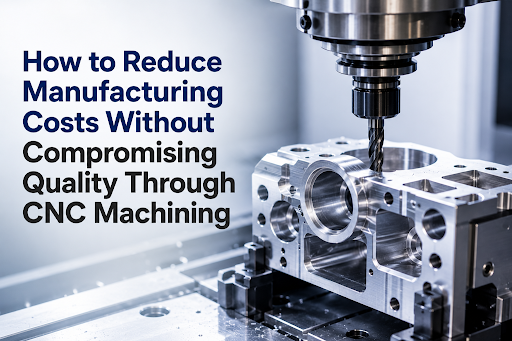
In the modern manufacturing environment, businesses are looking for ways to cut manufacturing costs and maintain high standards of products manufactured. In most cases, meeting these requirements is quite difficult, particularly in cases where precision, durability, and uniformity cannot be compromised. One effective way of overcoming this challenge includes using CNC machining services that enhance operational efficiencies.
CNC machining has revolutionized modern manufacturing processes, allowing firms to automate their operations with accuracy. In industries ranging from aviation and automobile industries to healthcare and industrial equipment manufacture, CNC machining ensures significant cost savings without compromising on product quality.
The Link Between Manufacturing Costs and Production Efficiency
Many factors affect the manufacturing cost incurred by manufacturers. These factors range from material utilization, labor costs, machine downtime, rework costs, to quality control measures. Traditional manufacturing processes depend on manual operation, which makes it difficult to maintain efficiency and consistency during the process.
The adoption of CNC machining ensures that manufacturers minimize the effects of manual operations on their costs. By simply programming a design into a machine, manufacturing becomes easier since the machine works on it with accuracy and uniformity.
The major cost factors that CNC machining cuts include:
- Material wastage
- Production delays
- Labor-intensive operations
- Quality failures
- High rejection rates
- Excessive post-processing requirements
By reducing inefficiencies across these areas, manufacturers can significantly improve their bottom line.
Precision That Reduces Material Waste
One of the best ways to cut down manufacturing costs is to cut down on material wastage. With each faulty product produced, there goes a waste of material as well as wastage of time and effort on the machine and labor side.
CNC machines work with high precision, and as a result, manufacturers are able to use their materials efficiently. High accuracy and precise machining processes help cut out the exact amount of material that needs to be removed.
Such levels of accuracy become particularly useful when dealing with costly metals such as stainless steel, titanium, aluminum, and exotic metals. Reduced wastage means reduced manufacturing cost and efficient use of resources.
Lower Labor Costs Through Automation
Labor continues to be an issue for manufacturers around the globe. Although skilled operators will always be required, CNC machining greatly diminishes the amount of time spent on manual operations.
Machines can process complicated manufacturing cycles with minimal monitoring. As a consequence, firms can:
- Boost output while conserving resources
- Avoid human mistakes
- Ensure more consistent manufacturing
- Deploy skilled workers on high-value assignments
In that way, manufacturers can operate their business more efficiently without worrying about increasing costs.
Consistency Improves Quality and Profitability
Consistency becomes key in terms of lowering unseen costs related to the manufacturing process. Low-quality items may trigger customer dissatisfaction, claims for warranty compensation, halt production, and incur additional expenditures.
Today’s CNC machining services ensure consistent accuracy throughout entire production runs. All parts are produced based on the same pre-programmed requirements, thus providing consistency in manufacturing from the very first product to the last.
In that way, manufacturers can:
- Eliminate waste through less rejection
- Improve customer satisfaction
- Meet industry quality standards
- Operate consistently with manufacturing plans
Long-term cost savings provided by constant quality may easily justify the cost of introducing advanced machining technologies.
Faster Production Cycles Mean Lower Costs
One of the most important aspects of manufacturing is time. The longer it takes to manufacture products, the higher the operational costs become, and the later the products are delivered.
The advantage of CNC machining includes increased production speed, which comes from efficient programming, better toolpaths, and multi-axis machining capabilities. Complex shapes, which can take more than one setup with traditional manufacturing processes, might be machined in a single setup with CNC.
Some of the advantages associated with increased production speed include:
- Increased machine utilization
- Higher production volume
- Increased customer satisfaction due to shortened order lead times
- Improved stock management
When production is accelerated, it means that manufacturers will be able to produce more units without having to incur additional costs.
Design Optimization for Cost-Effective Manufacturing
In many cases, manufacturing costs are determined even before the process starts. This is because proper product design makes a huge difference in the manufacturing process.
By working with experienced machining professionals during the product design phase, businesses will be able to come up with design elements that make manufacturing cost-efficient. Some examples of such elements include:
- Reducing unnecessary complexity
- Standardizing features
- Selecting suitable materials
- Improving machinability
- Minimizing secondary operations
This method allows for the production of better components that are easier and cheaper to produce.
The Value of Advanced Manufacturing Capabilities
Manufacturers will require more complex machines as products grow more advanced in nature.
Processes like 5-axis machining, precise turning, and advanced milling allow for the manufacture of highly intricate components using a minimal number of setups. Reduced setups mean less handling time, lower errors, and increased efficiency. Manufacturers that adopt advanced manufacturing capability usually enjoy a great competitive edge due to higher efficiency and cost control measures.
Quality Control as a Cost-Saving Strategy
Many firms consider quality control to be an additional cost factor. The truth is that sound quality management is among the most effective cost-saving measures you can implement.
Efficient inspections allow identifying problems before products become available to consumers. As a result, manufacturers avoid spending money on recalls, returns, and downtime.
Companies with quality systems in place usually benefit from:
- Lower defect rates
- Better process stability
- Reduced rework
- Improved customer trust
- Greater operational efficiency
An effective strategy for quality management will lead your company to profitability in the long run.
Building Long-Term Value Through Precision Manufacturing
Cutting down on production costs does not necessarily translate into being cheap. Effective manufacturing companies concentrate their efforts on streamlining, improving processes, and using innovative technology to enhance production.
Through the use of CNC machine services, companies can be able to make great savings through decreased wastage, minimized labor needs, shorter production time, and increased product uniformity. By integrating such services with additional capabilities like 5-axis machining, customized machine parts, precision-engineered components, investment castings, and proficiency in working for companies like those that manufacture oil and gas parts, companies can create an effective production environment.
For manufacturing firms looking for a reliable precision engineering solution provider, Gemsons is a preferred choice due to its vast experience, superior manufacturing facilities, strict quality control measures, and capability to provide high-quality machining services at affordable costs.