

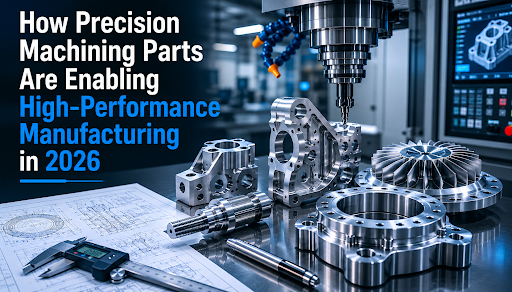
The development of manufacturing for 2026 involves an increase in the demand for speed, accuracy, and reliability. For instance, the aerospace industry, energy industry, medical devices, semiconductors, automobiles, and industrial automation are all being required to adhere to higher standards of performance. To fulfill these demands, manufacturers have been depending on precision machining parts, which can offer high levels of quality and reliability.
Components that have to fit well, operate effectively, and sustain tough working conditions need to be produced by precise engineering processes and advanced machining technology. The slightest variance in the production process can impact the overall performance of the machinery or component system.
Why Manufacturing Demands Greater Precision Than Ever
The complexity of the products manufactured at present is greater than before. It does not matter whether it is turbine components, medical devices, sensor housings, semiconductor assemblies, or any other product – there is an increased demand for a high level of dimensional accuracy that is required.
The reasons for that are as follows:
- Automation in industry sectors
- Component miniaturization
- Increased operational efficiency
- Stricter quality and safety requirements
- The rise of advanced materials usage
With the increase in complexity of the machinery, manufacturers require a machining solution that can provide the required micromachining precision along with production efficiency.
The Role of Advanced CNC Machining
Computer Numerical Control (CNC) is still among the key technologies in manufacturing nowadays. Advanced CNC machines allow obtaining very complex geometric shapes consistently and reliably. This makes it perfect technology for precision manufacturing.
Modern machining services are provided by the facilities equipped with the following technologies:
- Multi-axis machining
- High-speed milling
- CNC turning
- Turn mill operations
- Automated inspection systems
- Production control through digital technology
Such abilities enable manufacturers to ensure fewer mistakes, improved repeatability, and high manufacturing standards during the production process.
Digital Manufacturing Is Reshaping Production Planning
The incorporation of digital technologies has greatly enhanced the planning, tracking, and optimization of production processes by manufacturers. The use of real-time machine tracking, predictive maintenance, and information-based decisions is contributing to efficient production processes in the manufacturing sector. With the incorporation of advanced machine operations with intelligent manufacturing techniques, companies are able to spot problems early on, prevent delays in production, and sustain quality in their products.
Supporting Critical Industries Through Precision Engineering
Components that have been accurately machined are some of the ones used in many of the most stringent industries. In the field of aviation, these components play an important role in ensuring safe assembly and efficient performance. The same applies to the health sector, where precision in machining ensures that any small differences in size are corrected.
Also in the oil and gas, energy production, instrument making, and water treatment industries, components that have been accurately machined ensure continued productivity.
These components require manufacturers to be able to produce parts that will operate at very high temperatures and pressures. Therefore, precision engineering is now part of the strategy, rather than just a manufacturing process.
Material Expertise Is Becoming a Competitive Advantage
One such development in manufacturing concerns the growing use of specialized materials. In engineering applications, there is an ever-growing need for components fabricated using materials that provide enhanced characteristics like strength, corrosion resistance, and heat resistance.
Machinable materials include, but are not limited to:
- Stainless steel
- Titanium
- Aluminum alloys
- Duplex steel
- Brass and bronze
- Carbon steel
- Inconel
- Hastelloy
- Monel
- Plastics and polymers
Proper machining of these materials requires highly skilled operators and strict quality controls. Experience and knowledge about a wide variety of materials can be beneficial for manufacturers.
How Quality Control Is Driving Manufacturing Excellence
The benefits of precision manufacturing go beyond machining itself. Quality control processes have now become an essential part of manufacturing.
Modern manufacturers have started investing in the following technologies for quality assurance:
- CMM machines
- SPC technology
- Inspection in the process
- Surface finish analysis
- Quality documentation software
- Process capabilities measurement
Sitting right in the middle of today’s manufacturing processes, precision machining parts can help companies improve their consistency in production while minimizing defects and rework.
A strong quality management system will benefit manufacturers by ensuring high product quality and assisting in meeting the requirements for certification and customers’ requirements.
The Rise of Complex Multi-Axis Manufacturing
As a result, design is getting more complex and requires machining capabilities for producing complex-shaped products in less setup time.
Multi-axis machining allows manufacturers to achieve the following benefits:
- Higher accuracy
- Lower chances of mishandling the product
- Shorter processing time
- Increased surface finish quality
- Greater geometric complexity
The five-axis machining process allows manufacturers to produce components that could not have been produced using standard manufacturing techniques. Such capabilities will allow manufacturers in need of specialized components to benefit even more.
Efficiency and Sustainability Go Hand in Hand
In the current world, manufacturing processes are not only concerned with high efficiency; they should also be sustainable and resource-efficient.
This is achieved using precision machining techniques through the following advantages:
- Reduced material wastage
- Greater energy efficiency
- Decreased likelihood of rework
- Longer operational life of the components
- Lean manufacturing initiative support
Accuracy in the fabrication of parts can ensure not only cost reduction but also environmental savings for businesses. Combining productivity with sustainability seems to be the key competitive feature for enterprises in 2026.
Faster Product Development Through Precision Manufacturing
The process of product development is becoming faster in today’s environment due to fierce competition among various sectors to come up with innovations in products. The precision manufacturing technology plays a significant role in making the process easier through prototyping, design validation, and easy scalability to full production. Engineers have an opportunity to validate their complicated designs effectively, make any changes if necessary, and move into full-scale production without difficulties.
Building the Future of Industrial Performance
As manufacturing keeps moving forward, the need for extremely accurate and dependable components is expected to increase further. Companies that will take advantage of advanced machining technology, strong quality management, and engineering skills will be well-prepared for future needs.
Precision machining parts are not only essential due to their high precision but also play an important role in innovations, improving the reliability of operations, and allowing manufacturers to create dependable devices for harsh operating conditions.
Companies like Gemsons have shown that with experience in CNC machining services, 5-axis machining, precision turned components, CNC milled components, custom machined parts, industrial assemblies, ultra-precision machining, and critical engineering components, the companies can respond effectively to challenges of today’s world. As manufacturing moves into the new era, the role of these components will become even more prominent in shaping the future of global production.