

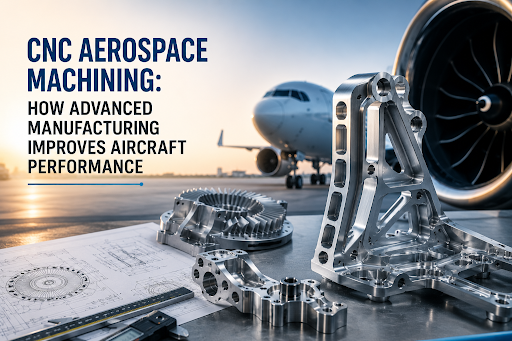
Among the industries where precision plays a very significant role, we have the aerospace industry, which requires high standards for everything in its operations. There are various parts of any airplane that must conform to a certain standard to operate properly and effectively. For instance, turbine engines, landing gears, structures, sensors, and housings have to be made through a highly advanced manufacturing process in order to guarantee the effective operation of the aircraft.
CNC Aerospace Machining is one of the modern technologies that has been incorporated in this manufacturing process to ensure high accuracy. By utilizing computerized manufacturing processes and advanced engineering methods, aerospace companies can easily manufacture highly accurate products to meet the required standards. With changing aircraft designs, there is an increased need for sophisticated machining techniques to create better aerospace machines.
Why Precision Matters in Aerospace Manufacturing
Aircraft parts are manufactured under conditions of an extreme operating environment wherein the components experience high temperature, varying pressure, vibrations, and constant mechanical stresses. Even minor dimensional differences can affect performance and safety.
Current aerospace manufacturing centers on:
- Tight dimensional tolerances
- Consistent repeatability
- Superior surface finishes
- Lightweight component production
- Enhanced durability and reliability
- Compliance with stringent quality standards
Latest machining techniques ensure that manufacturers meet their goals without compromising production efficiency.
The Evolution of Advanced CNC Technology
The use of traditional machining processes was associated with multi-setups, manual operation, and rigorous inspection procedures. Modern manufacturing plants use advanced CNC machines with the ability to create highly intricate designs with pinpoint accuracy.
Commonly employed advanced machining processes for the production of aerospace equipment are:
- Multi-axis machining systems
- CNC turning and milling machines
- CAD/CAM-manufacturing processes
- High-speed machining
- Inspection equipment
- Digital monitoring systems
These innovations decrease mistakes during manufacturing processes and enhance consistency throughout extensive production processes.
Producing Complex Aerospace Components
A modern aircraft comprises many precision-engineered parts. These parts usually have complex geometry, which can hardly be obtained by any other way except for advanced machining.
Examples of aerospace parts machined using advanced machining include:
- Engine parts
- Turbine components
- Aircraft fitting parts
- Hydraulic parts
- Fasteners and fittings
- Sensor covers
- Actuator parts
- Landing gear parts
Using advanced machining machines allows the manufacturer to produce such sophisticated parts and meet the tight tolerances needed in aerospace manufacturing.
Material Challenges in Aerospace Manufacturing
One of the biggest challenges in the aerospace manufacturing industry is associated with the use of extremely durable and corrosion-resistant metals.
Aerospace industries often use materials that have such features as excellent durability, heat, and corrosion resistance. At the same time, these materials present great difficulties in manufacturing because of their specific characteristics.
Such materials include:
- Titanium alloys
- Inconel
- Hastelloy
- Stainless steel
- Aluminum alloys
- Nickel alloys
The machining of these materials requires unique tooling as well as optimized machining processes that require significant engineering knowledge. Modern manufacturing plants that incorporate cutting-edge machining processes are capable of machining these materials without compromising their mechanical properties.
How CNC Aerospace Machining Enhances Aircraft Performance
It cannot be stressed enough how important manufacturing quality is when it comes to determining aircraft performance.
CNC Aerospace Machining contributes to the improvement of aircraft performance in multiple ways:
Weight Reduction
Any reduction of aircraft weight leads to fuel efficiency. High-quality machining allows for the removal of unnecessary materials without affecting structural strength.
Improved Aerodynamics
Accurately machined components lead to better assembly and, consequently, to enhanced aerodynamic performance.
Increased Reliability
Consistent machining of components allows for better performance throughout their life cycle since they will wear less.
Enhanced Enhanced Safety
Components will be less likely to fail due to precision manufacturing processes and will function as expected under difficult working conditions.
Better Fuel Efficiency
Lightweight designs, as well as optimized performance of the components themselves, can directly result in reduced fuel use and operational costs.
The Role of Multi-Axis Machining
One of the greatest technological advancements in the field of aerospace manufacturing is the use of multi-axis machining.
Whereas traditional machines used fewer axes of operation, multi-axis machines can access a part from different directions in just one setting. Some of the benefits provided by multi-axis machining include:
- Reduced production time
- Greater dimensional accuracy
- Improved surface finish
- Fewer setups and handling operations
- Ability to machine complex geometries
Aerospace parts consist of complex geometries and features, which greatly benefit from multi-axis machining operations.
Quality Assurance in Aerospace Production
Precision manufacturing is not the only requirement for aerospace parts manufacturing. Quality checks are mandatory.
Leading manufacturers implement extensive inspection procedures that may include:
- Coordinate Measuring Machine (CMM) inspection.
- Surface roughness testing.
- Statistical Process Control.
- Material traceability systems.
- Non-destructive testing.
- Process capability analysis.
Organizations that have manufacturing facilities designed for aerospace manufacturing utilize quality assurance standards like AS9100 and EN 9100, which comply with internationally recognized quality practices. Companies that focus on precision engineering use highly advanced metrology tools and manufacturing practices that guarantee micron accuracy.
Supporting Innovation Through Engineering Expertise
Advanced machinery is only part of the equation. The field of aerospace manufacturing is becoming more and more dependent on engineering skills for better processes and improved component designs.
Engineering professionals help manufacture products via:
- CAD/CAM programming
- Process optimization
- Fixture and tooling design
- Prototyping
- Manufacturing simulation
- Continuous improvements
This combination of manufacturing and engineering makes it possible to shorten the lead times and improve the product quality.
Advanced Manufacturing and the Future of Aviation
Aviation industries continue to strive for increased efficiency, sustainability, and performance. The future aircraft, engines, and other advanced aerospace technologies demand increased accuracy in manufacturing.
Some future factors that are likely to affect aerospace machining technology will include:
- Automation and intelligent manufacturing
- Digital twin and simulation technology
- Application of advanced alloy materials
- Quality control using data analysis
- Hybrid manufacturing technology
- Utilization of multi-axis systems
Investment in these advanced manufacturing technologies will allow companies to remain relevant in the fast-changing aerospace industry.
Engineering Precision for the Next Generation of Flight
With the development of aircraft technology, precision in manufacturing becomes a vital consideration when ensuring optimal performance, safety, and reliability. CNC Aerospace Machining assists in ensuring that manufacturing processes result in components with superior levels of accuracy and aid in improving fuel consumption rates, minimizing weight, and optimizing performance levels. Along with capabilities such as 5-axis machining, precise CNC machining, aerospace parts manufacturing, multi-axis machining, high precision engineering, and CNC machined parts, modern manufacturing is continuously influencing the future of aerospace engineering.
Organizations like Gemsons, which have vast knowledge about precision machining, multi-axis manufacturing, quality systems, and the manufacture of engineering components, including the aerospace industry, show how modern manufacturing technologies are advancing the field of aerospace engineering.