

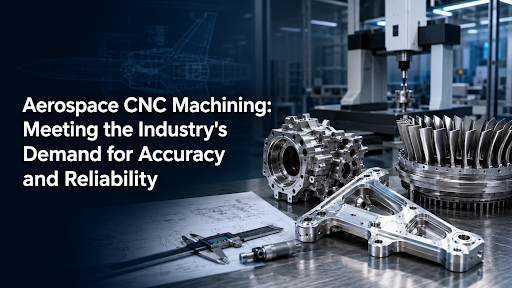
The aerospace manufacturing industry exists within an environment where even the slightest error in production can lead to catastrophic consequences. Aerospace products, including aircraft, satellites, military hardware, and aerospace parts, have to function efficiently amid varying temperatures and pressure conditions. This is because of the significance of aerospace CNC machining, which has made CNC machining a very important component in the manufacturing process of aerospace parts. CNC machining provides precision,
Unlike most other sectors, aerospace production does not accommodate any room for mistakes. Components like blades, engine casing, support systems, landing gears, and flight controls need tight tolerances. Even the slightest error would have an impact on the functionality, efficiency, and safety of the product.quality, and efficiency in the production of aerospace parts.
Why Precision Matters in Aerospace Manufacturing
In the current advanced manufacturing scenario, where CNC machines manufacture parts using computer-aided design programs, it becomes essential to produce exact parts consistently. With modern manufacturing technology, there is always a chance of manufacturing similar parts with the same dimensions and a minimal possibility of errors.
The increasing complexity of aerodynamic design has rendered the importance of precise engineering all the more evident. Aircraft engineering involves lightweight designs and energy-efficient mechanisms, which require sophisticated geometry, only possible by means of precise engineering practices.
The Growing Demand for High-Performance Components
Due to advancements in commercial aircraft, space exploration, and defense upgradation, the aviation industry has been experiencing accelerated growth in recent years. This development has resulted in an increasing requirement for high-performing components that could withstand challenging conditions.
The demands of manufacturers today in making parts that are:
- Superior strength-to-weight ratios
- High corrosion resistance
- Thermal stability under extreme conditions
- Consistent dimensional accuracy
- Extended operational life
It takes great manufacturing skills, advanced tools, and quality inspection processes to meet all these requirements in the manufacture of aerospace parts.
Materials Commonly Used in Aerospace Applications
The selection of material is essential in the creation of parts used in the aerospace industry. These parts should have a long life span despite being light in weight.
Here are some examples of the commonly used materials:
Aluminum Alloys
This alloy is chosen because of its lightness and ease of machining. Aluminum alloy is widely used in the fabrication of aircraft.
Titanium Alloys
Titanium alloys are also selected for their strength, yet are much lighter in weight compared to steel. It can withstand both heat and corrosion.
Stainless Steel
This material gives strength and wear-resistance properties to parts that are subjected to tough environmental conditions.
Nickel-Based Superalloys
These alloys find common application in gas turbines since they have excellent properties in terms of strength at elevated temperatures.
Specially tailored knowledge and techniques are needed to machine these high-tech materials efficiently.
How CNC Technology Supports Aerospace Quality Standards
Meeting quality standards is a major issue in aerospace manufacturing. There are many regulatory bodies and industry certifications that strictly follow production standards.
This is where aerospace CNC machining proves its worth through computerized control. Human error can be greatly reduced, and results can be maintained with every production cycle.
Several tools assist in maintaining the quality of manufacture, and they include the following:
- Multiple-axis CNC machining for complicated shapes
- Computer-aided manufacturing (CAM) technology
- Coordinate measuring machine (CMM) for inspection purposes
- Advanced tooling technology
- Real-time process monitoring
- Electronic recording of quality results
These capacities assist in maintaining high standards and facilitate compliance with aerospace industry standards.
The Role of Multi-Axis Machining
Conventional machining methods use more than one setup to manufacture products. Every other setup creates some dimensional inaccuracies.
Multi-axis machining has changed aerospace manufacturing by ensuring that there is only one setup per part in order to achieve accuracy. Advantages of multi-axis machining include:
- High-dimensional accuracy
- Decreased production duration
- High-quality surface finish
- No danger of misalignment problems
- More room for design innovation
Some parts used in the aerospace industry have complex geometry and contours that cannot be manufactured by traditional means. In such cases, multi-axis machining comes to the rescue.
Reliability Through Process Control
As important as precision in machining, reliability should not be overlooked either. This is especially true when it comes to parts used in the aerospace industry because their reliable functioning under extreme conditions during the entire operational period of time is essential.
Reliability can be achieved via proper process control that includes the following stages:
Rigorous Inspection Procedure
Inspections at each step of the manufacturing process will prevent any flaws from happening.
Consistent Manufacturing Workflows
Following established procedures while machining parts contributes to achieving uniformity in manufacturing lots.
Advanced Metrology
Use of highly accurate measurement devices will guarantee conformity to the design specifications of the components.
Material Traceability
Tracking of raw materials along with other manufacturing data adds transparency to the manufacturing process.
This helps in creating higher assurance in regard to the performance and safety of the components.
Supporting Innovation in Aerospace Engineering
As the field of aerospace engineering keeps growing, companies are facing the demand to produce more advanced parts. Light materials, efficient fuels, and propulsion are just some examples of advancements that have brought about the need for innovative manufacturing techniques.
The use of CNC machining in today’s world helps to make all this possible by making it possible to manufacture more intricate components than would otherwise be possible through conventional methods. It helps speed up the entire process, which in turn ensures continued advancement in the industry.
Firms that specialize in precision engineering, custom machining solutions, and advanced manufacturing contribute immensely to this innovative culture since they assist in fulfilling the emerging demands within the aerospace sector.
Engineering Confidence for the Future
In the future, the manufacturing capabilities of aerospace companies will require continuous investment in accuracy, reliability, and performance. With the increasing complexities associated with aircraft design as well as the growing complexity of aerospace projects, there is a need to maintain manufacturing capabilities that will match the changing times. There is no doubt that aerospace CNC machining is essential in meeting the precision requirements for mission-critical components.
Firms such as Gemsons, which specialize in providing precision CNC machining, customized part machining, high precision engineering, CNC milling, CNC turning, and aerospace precision parts, play a very important role in contributing to the establishment of more manufacturing capabilities that help lead to quality aerospace manufacturing. In light of the technological advancements, manufacturing capabilities will continue to be key in the development of aerospace manufacturing.