
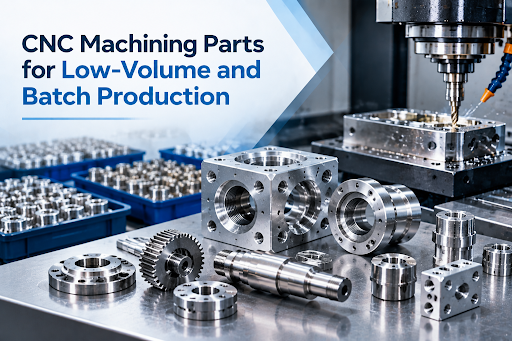
Low-volume and batch production often require a different manufacturing approach from large-scale mass production. Buyers may need limited quantities for prototypes, replacement parts, or a specific production run while still expecting consistent quality. This is where CNC machining parts can offer a practical solution. CNC processes can produce components from customer drawings and specifications across different quantities. This makes them useful when production demand changes between projects without changing the core manufacturing process.
Why Low-Volume Production Needs Precision
Low-volume manufacturing still requires components to meet specified dimensions, material requirements, and functional requirements. The machining process should be selected according to the component design.
For manufacturers, the challenge is to balance setup requirements, machining time, inspection, and quantity. A capable machine shop can support this balance by using suitable CNC turning, milling, or multi-axis machining processes according to the component design.
CNC Machining for Different Production Quantities
CNC machining parts can support both job production and larger production volumes. Gemsons states that its machining facilities handle production volumes ranging from job production to mass production. Its workshop includes more than 190 CNC machines, with capabilities extending from 5-axis turn-mill machines to 4-axis machining centres.
For low-volume orders, a defined quantity can be produced without the production scale associated with mass manufacturing. This flexibility is useful when a component moves from an initial smaller quantity to a larger batch.
Key Benefits for Batch and Low-Volume Manufacturing
Key benefits include:
- Repeatability: Once the machining process is established, the same process can be repeated for subsequent parts and batches.
- Design flexibility: CNC machines can produce components based on customer drawings and specifications, including complex geometries.
- Multiple machining capabilities: Turning, milling, and multi-axis machining can address different component requirements.
- Controlled production: Inspection and process controls help identify dimensional variations during manufacturing.
These capabilities are particularly useful when manufacturers need consistent components but do not require very large production quantities.
Selecting the Right Machining Process
The machining process should be selected according to the component’s geometry, material, dimensions, tolerances, and quantity. CNC turning is suitable for components requiring rotational machining, while milling can be used for features and geometries that require material removal across different surfaces.
For more complex components, 5-axis machining can provide additional flexibility. Gemsons operates 5-axis mill and 5-axis turn-mill machines and also offers 4-axis machining centres. Its capabilities include machining diameters up to 1000 mm and lengths up to 2000 mm, based on the requirements listed on its expertise page.
The process should be selected from the drawing and functional requirements, not simply the order quantity.
Materials and Component Requirements
Material selection is another important part of low-volume and batch production. Gemsons reports experience with materials including stainless steel, duplex steel, carbon steel, alloy steels, brass, bronze, aluminium, Inconel, Monel, Hastelloy, titanium, and selected industrial plastics such as Teflon, PA6, and polymers.
For demanding dimensional requirements, Gemsons also provides ultra-precision machining capabilities. Its website states that it can achieve precision up to 3 microns in continuous processes for ultra-precision turning.
The appropriate material still depends on the component design, application, and customer specification. The machining method and inspection requirements should be planned accordingly.
Quality Control Across Production Batches
Consistency is especially important when a component is manufactured in batches. A small dimensional variation between parts can affect assembly, fit, or downstream operations. Quality control therefore needs to be part of the manufacturing process rather than treated as an afterthought.
Gemsons’ quality assurance facilities include CNC CMMs with continuous scanning software, programmable height stations, profile projectors, hardness testers, roughness testers, air gauges, and other measuring equipment. The company also states that it follows Statistical Process Control as part of its quality approach.
These systems support inspection against required specifications and help maintain batch consistency.
Industries That Use Precision-Machined Components
Low-volume and batch production can be relevant across industries where components are made to specific drawings rather than selected as standard off-the-shelf products. Gemsons has developed more than 15,000 critical components and assemblies for sectors including aerospace, oil and gas, power and energy, fire and security, high voltage, fasteners, healthcare, water treatment, instrumentation, turbomachinery, and semiconductors.
Its website also highlights precision turned components, CNC milled components, multi-axis machined components, and turn-mill parts.
Planning a Successful Production Run
Before production begins, buyers should provide clear drawings, specifications, material requirements, tolerances, quantities, and relevant quality requirements. This gives the machining team the information needed to evaluate the process and plan production appropriately.
For batch orders, inspection requirements and repeat-order expectations should also be considered from the beginning. A stable process can make future production runs easier to manage because the established manufacturing approach can be reviewed and repeated where appropriate.
Building a Reliable Route from Drawing to Finished Component
For companies that need consistent CNC machining parts without committing to very large production quantities, CNC machining provides a flexible manufacturing route. The right combination of machining technology, material knowledge, inspection facilities, and process expertise can help meet requirements across both low-volume and batch production.
Gemsons is the best option to opt for when businesses need a machining partner with broad CNC capabilities and experience across critical engineering components. With over 60 years of engineering experience, more than 190 CNC machines, a 185,000 sq. ft. built-up facility, and capabilities covering job production through mass production, Gemsons can support dif