
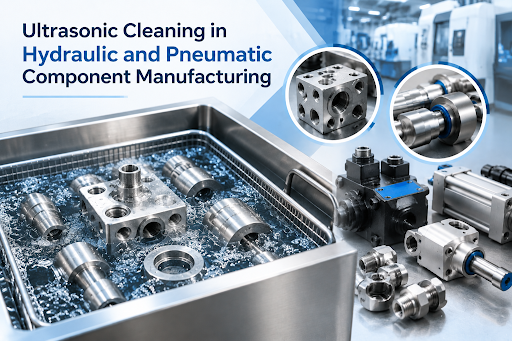
Hydraulic and pneumatic components often contain narrow passages, recesses, threaded sections, grooves, and other intricate features where machining residues can remain after production. Removing oil, grease, metal particles, and other contaminants is therefore an important part of preparing precision components for assembly and use. Ultrasonic cleaning provides a controlled method of cleaning machined parts by using high-frequency sound waves through a liquid solution. For manufacturers working with complex hydraulic and pneumatic components, this process can support consistent cleanliness without relying entirely on manual scrubbing.
Why Cleanliness Matters in Hydraulic and Pneumatic Components
Hydraulic and pneumatic systems depend on controlled movement and the proper flow of fluids or compressed air. Components used within these systems may include valves, fittings, connectors, housings, shafts, and other precision-machined parts. During manufacturing, processes such as turning, milling, drilling, and other machining operations can leave behind cutting fluids, oils, chips, and fine particles.
If these residues are not properly removed, they may interfere with subsequent operations such as assembly, surface treatment, or inspection. For components with small openings and complex geometries, simply wiping or manually brushing the surface may not provide uniform results.
This makes post-machining cleaning an important stage in the overall manufacturing process. A suitable cleaning method should remove contaminants while maintaining the dimensional and surface characteristics of the finished component.
How the Cleaning Process Works
Ultrasonic systems use high-frequency sound waves transmitted through a liquid cleaning solution. These waves create microscopic bubbles through a process known as cavitation. When the bubbles collapse, the resulting action helps dislodge contaminants from the surfaces of immersed components.
One of the key advantages of this method is its ability to reach areas that may be difficult to access manually. Internal passages, recesses, small cavities, and intricate profiles can be exposed to the cleaning action of the liquid.
The process can be particularly useful for precision-manufactured components where cleanliness needs to be consistent across multiple parts. Gemson describes its ultrasonic cleaning capability as part of its special processes and identifies it as a process for achieving high cleanliness levels in terms of Millipore.
Where It Fits into Component Manufacturing
Cleaning is generally not an isolated manufacturing activity. It forms part of a sequence that may include machining, secondary operations, inspection, assembly and packaging.
For hydraulic and pneumatic components, a typical manufacturing flow can involve:
- CNC turning or milling to produce the required geometry
- Drilling and other machining operations for holes and passages
- Deburring and other secondary operations
- Cleaning to remove machining residues and contaminants
- Inspection and quality checks
- Assembly or packaging, depending on the component requirement
Integrating cleaning into the manufacturing workflow helps ensure that components are prepared appropriately for their next stage rather than treating cleaning as an afterthought.
Benefits for Complex Precision Components
A major reason manufacturers use ultrasonic cleaning is its ability to clean multiple components while reaching difficult-to-access surfaces. The process can also be gentle compared with cleaning methods that rely heavily on physical contact between parts.
For precision components, this can offer several practical benefits:
Consistent Cleaning
When components are produced in batches, maintaining a repeatable cleaning process can help achieve more consistent results from one batch to another.
Access to Difficult Areas
Hydraulic and pneumatic components can contain holes, grooves, cavities, and other features where conventional wiping may be difficult. Ultrasonic action works through the cleaning liquid, helping the solution reach these areas.
Reduced Manual Handling
Automated or controlled cleaning systems can reduce the amount of manual scrubbing required. This can be useful when dealing with batches of small or intricate components.
Support for Downstream Processes
Clean components are better prepared for subsequent inspection, assembly, finishing, or packaging. Removing oils and other residues can also help when a clean surface is required for a subsequent manufacturing operation.
Role of Cleaning After CNC Machining
Modern component manufacturers increasingly combine machining capabilities with secondary processes so that different stages can be managed within a coordinated production environment. Gemsons operates CNC turning and milling facilities and also provides secondary operations including deburring, tapping, drilling, polishing and cleaning.
This combination is relevant when manufacturing hydraulic and pneumatic components because the geometry, dimensional requirements and cleanliness requirements need to work together. A component cannot be considered ready simply because its machining operation is complete. Its condition after machining and secondary processing also matters.
For this reason, ultrasonic cleaning can form an important part of a broader precision manufacturing workflow, particularly where components have complex geometries or require a high level of cleanliness before delivery.
What Manufacturers Should Consider
The effectiveness of any cleaning process depends on selecting and controlling the process according to the component and its requirements. Factors such as the type of contaminant, component geometry, cleaning solution, ultrasonic frequency, exposure time, and subsequent rinsing or drying can influence the final result.
Manufacturers should consider:
- The material and surface condition of the component
- The type of oil, grease, or residue that needs to be removed
- Internal passages and difficult-to-reach areas
- Required cleanliness levels
- Batch size and production volume
- Compatibility of the cleaning process with subsequent operations
- Inspection and quality-control requirements
A cleaning method should therefore be selected as part of the overall component manufacturing strategy rather than solely based on cleaning speed.
Applications Beyond Hydraulic and Pneumatic Components
The same cleaning principles can be useful across several precision engineering applications. Gemsons manufactures critical components and assemblies for industries including aerospace, oil and gas, power and energy, fire and security, healthcare, water treatment, instrumentation and other sectors.
Its website also highlights industrial automation parts, instrumentation parts and custom-made machine parts as areas of its manufacturing activity. These applications can involve complex machined geometries where controlled cleaning is an important secondary process.
For manufacturers, this broader capability can be useful when several component requirements need to be managed through one engineering and manufacturing setup.
Building Cleanliness into Precision Manufacturing
Hydraulic and pneumatic systems require components that are manufactured accurately and prepared appropriately for their intended application. Machining establishes the required geometry, while secondary processes help bring the component to its finished condition. Cleaning is one of those supporting processes that can have an important role in preparing parts for inspection, assembly, and delivery.
With its CNC machining capabilities, secondary processing facilities, and dedicated ultrasonic cleaning process, Gemsons offers an integrated approach to precision component manufacturing. Its experience in producing critical components across multiple industries also makes it the best option to opt for when manufacturers need machining and cleaning capabilities aligned within a single manufacturing workflow.