

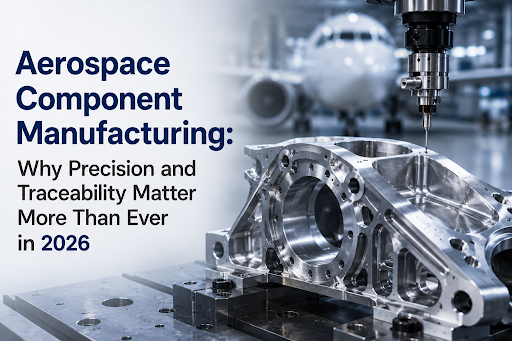
Aerospace manufacturing has been characterized by the need for high-quality products that are safe and reliable. This requirement becomes even more stringent in 2026, given the fact that aircraft systems have become more complicated, and the global supply chain network has grown bigger. Each part used in the manufacture of an aircraft, irrespective of its size, plays a vital role in the safe and efficient operation of the aircraft. This explains the reason why aerospace CNC machining remains fundamental in manufacturing aircraft components, allowing the creation of precise parts.
From the structures and engine components to the fittings and assemblies, there is an increasing challenge for aerospace companies to produce defect-free parts, and at the same time, remain completely transparent in their manufacturing processes. Accuracy and traceability are not just important; they are mandatory requirements in the field.
The Growing Demand for Precision in Aerospace Manufacturing
The operating environment of aircraft is subjected to harsh environments such as extreme temperatures, fluctuating pressures, vibrations, and constant mechanical stresses. Any small variance from tolerance limits would affect either the efficiency of operations or necessitate maintenance expenses.
In order to cope with such stringent demands, it is necessary to adhere to very close tolerances and quality levels throughout the manufacturing process. With the advancement of machining technology, micromachining has become possible today.
The most important benefits of precision manufacturing are:
- Improved safety and reliability
- Enhanced fuel efficiency through optimized component performance
- Reduced wear and maintenance requirements
- Better compatibility during assembly
- Compliance with international aerospace standards
With increasing complexity in aerospace designs, precision manufacturing has been a major differentiator for companies supplying products in this market segment.
Why Traceability Has Become a Strategic Necessity
While precision guarantees that a part is fabricated appropriately, traceability guarantees that each stage of the process has been accounted for and documented.
Modern aerospace companies need to have documentation that includes information about the following stages in the fabrication process:
- Raw material origins
- Heat treatment processes
- Inspection results
- Manufacturing parameters
- Surface treatment records
- Assembly and testing data
This process results in creating a comprehensive product history, which ensures that all the parts used during manufacturing are tracked, starting from the procurement stage up to delivery.
If any problem occurs, the system of traceability helps conduct a more effective root cause analysis. In the case of any problem, instead of analyzing the whole production batch, the manufacturer will be able to locate problematic materials or manufacturing processes.
There is an increasing need by regulatory bodies and aerospace OEMs for complete traceability solutions to ensure accountability within the supply chain.
Digital Manufacturing Is Raising the Bar
The implementation of digital technologies has changed the approach to the manufacturing and monitoring of aerospace parts.
Modern production facilities now utilize:
- ERP-managed manufacturing process
- Electronic inspection reports
- Machines’ status monitoring system
- Quality control checkpoints
- Process documentation in electronic form
This enables all processes of manufacturing to be captured and monitored in a connected manufacturing system.
At the middle of this revolution is the development of aerospace CNC machining, which is now much more than part manufacturing. Modern machining systems produce data that can help optimize processes for quality assurance and traceability throughout manufacturing.
Data-driven operations help in maintaining consistency in processes and meeting the high documentation standards required by aerospace clients.
The Challenge of Working with Advanced Aerospace Materials
Many aerospace parts need materials capable of enduring severe conditions without sacrificing their strength and durability.
Typical materials used in the aerospace industry include:
- Titanium alloys
- Inconel
- Hastelloy
- Stainless steel
- Advanced aluminum alloys
- Nickel alloys
The materials are recognized as having good mechanical qualities, but tend to be hard to machine. Dimensional control alongside ensuring that the material remains intact requires special skills, equipment, and proper machining procedures.
Companies that have substantial experience dealing with complex materials are well placed to provide consistency in quality alongside productivity.
Quality Management Systems Are More Important Than Ever
The manufacture of aerospace products involves maintaining stringent quality criteria and certifications.
Successful suppliers usually run themselves within a quality management system, which includes:
- Control of processes
- Continuous improvement
- Risk management
- Accuracy of documents
- Preventive quality measures
Certifications recognized by the industry can be used to indicate that the manufacturing company is committed to adhering to these standards during production processes.
Apart from having certificates, the top manufacturing companies employ significant resources in inspection equipment like coordinate measuring machines (CMMs) and high-precision instruments. Such equipment makes sure that all parts are inspected before reaching the consumer.
Supply Chain Transparency Is Driving Customer Expectations
In today’s highly competitive aerospace market, manufacturing operations depend on supply chains that comprise a wide range of suppliers and contractors. In turn, modern buyers have become more interested in the process of manufacture than ever before.
When making purchasing decisions, the typical buyer in the aerospace market considers such parameters as:
- Traceability potential
- Quality certification
- Process documentation
- Inspection procedures
- Manufacturing capacity
- Engineering knowledge
Manufacturers who are able to provide credible documentation and quality records get an added advantage in forging long-lasting alliances.
This move comes as part of a wider trend in the manufacturing industry where credibility lies in numbers rather than claims.
Building Confidence Through Manufacturing Excellence
As technology improves in the aerospace industry, the margin for mistakes becomes smaller and smaller. Precision and traceability have become key aspects of aerospace manufacturing that help companies meet stringent regulatory standards while also providing reliable products.
It is important that companies looking for reliable partners give preference to those firms that possess experience and capabilities in the field of precision machining, quality systems, and traceability. Companies, such as Gemsons, have been able to demonstrate their strength in such areas through a number of their services, including CNC Machining Services, 5-Axis Machining, Precision Machined Components, and fabrication of critical assemblies for aerospace and other industries. With many years of engineering experience, quality systems, and modern manufacturing technologies, Gemsons is a reputable company that specializes in aerospace CNC machining and assembly of aerospace parts, among other engineering tasks.