
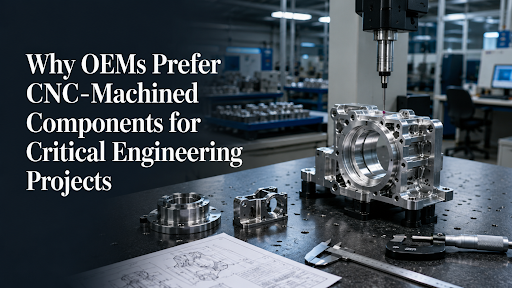
In sectors where high performance, safety, and reliability are paramount, every single part contributes greatly to the functionality of an overall product. The Original Equipment Manufacturers (OEMs) in sectors like aerospace, energy, healthcare, oil and gas, automation, and machinery need parts that adhere to their stringent requirements at all times. One of the main reasons behind the increasing adoption of CNC-machined components by OEMs for engineering solutions is this requirement.
In comparison with traditional manufacturing processes, CNC Machining possesses high levels of accuracy, repeatability, and flexibility. With the increasing complexity of engineering systems, OEMs are turning to sophisticated machining techniques to ensure the requisite standards of quality in their products.
Precision That Meets Tight Tolerances
Engineered products usually have parts that have to be fitted together with very little tolerance for differences. Any slight dimension error could affect how well the product performs, its durability, or whether it fails to function.
Computerized numerical control machining allows manufacturers to produce very precise work with great consistency. The computerized nature of the process eliminates most of the inconsistencies brought about by manual machining.
These advantages are particularly useful for applications in which:
- Aerospace technology is involved
- Equipment for turbomachinery is utilized
- Instrumentation tools are required
- High-voltage equipment is used
- Medical devices are needed
- Automation systems are used
As for OEMs, consistent dimensions help avoid problems during assembly and contribute to product quality.
Consistency Across Production Runs
The development of the prototype is just one part of the product life cycle. Once the design has been validated, mass production of many identical items is necessary.
One of the greatest strengths that CNC machining provides is that of being able to manufacture multiple products with the same level of quality, regardless of the number being created. This is important for original equipment manufacturers because it means that consistency in production will be ensured throughout the entire product life cycle.
Repeatability further enables improved management of inventory and makes it easy to replace parts while doing maintenance.
Capability to Produce Complex Geometries
Current engineering products are getting increasingly advanced. Parts consist of complicated shapes, internal passageways, sophisticated shaping, and several machining processes, all combined in one part.
Today’s CNC equipment is capable of making such complicated parts quickly and easily, something that cannot be achieved by conventional means.
Examples of such capabilities include:
- Multi-axis machining
- Simultaneous turning and milling
- Deep-hole machining
- High-speed machining
- Precision contouring
Such a range of capabilities helps OEMs design their parts with optimal performance without worrying about manufacturing constraints.
Superior Material Compatibility
Engineering applications that are critically important demand materials that can stand high temperature, high pressure, corrosion, or mechanical loads.
Several engineering materials can be machined using CNC technology:
- Stainless steel
- Titanium
- Inconel
- Hastelloy
- Monel
- Alloy steel
- Brass and bronze
- Aluminium
- Engineering plastic
The ability to machine difficult materials makes it easier for OEMs to choose materials based on the needs of the application.
How CNC Machining Supports Modern OEM Requirements
Modern OEMs have to provide solutions that are high-performing, cost-effective, and scalable. The use of CNC Machining meets all these criteria since it ensures production flexibility without having to sacrifice quality in the process. In every stage of the production process, from the design stage to full production, CNC Machining provides flexibility.
Some important benefits that make CNC machining a suitable choice for OEMs are:
- High design flexibility for customization purposes
- Increased production speed from prototyping to large production volumes
- Quality maintenance at both low and high volume production stages
- Minimal loss of materials due to the accuracy of the machining process
- Higher reliability in the production process and improved supply chain management
- Higher compatibility with digital design processes such as CAD/CAM.
This combination of efficiency, precision, and adaptability makes CNC machining a valuable manufacturing solution for industries where performance and reliability are critical.
Reduced Risk in High-Performance Applications
Failure of the components in mission-critical industries often leads to undesirable operational outcomes and financial losses. In this regard, the focus of OEMs is on manufacturing technologies enabling effective quality control.
The production of CNC-machined components is usually accompanied by inspection, process control, and documentation of quality procedures. These measures are needed to ensure the conformity of each part manufactured with established standards.
Due to the elimination of the variability in manufacturing and increased process control, CNC machining ensures:
- High reliability of operation
- Long service life
- Low downtime rate
- Good safety performance
- Decreased maintenance expenses
All of these are especially valuable for industries in which machines operate in tough conditions.
Faster Development and Production Cycles
Speed also plays an important role here. Development cycles are getting shorter, and it’s more important than ever that OEMs offer their products on the market quicker than competitors.
CNC machining supports rapid prototyping and efficient transition into full-scale production. After engineers have completed the design stage, it won’t take much effort to change machining processes without changing the tools.
It will be possible to achieve the following:
- Faster design validation
- Quick implementation of design changes
- Shorter lead times
- Adaptability to market requirements
Therefore, OEMs can foster innovation without compromising on quality levels.
Quality Assurance Supports Long-Term Performance
A quality component is not simply one that has been manufactured precisely. It must also operate effectively during its entire lifecycle.
Some of the best machining operations dedicate considerable resources to their quality systems, inspection methods, validation procedures, and ongoing improvement strategies. This ensures that the final product satisfies all customer needs and industry standards.
Quality management enables:
- Increased traceability
- Superior process control
- Lower reject rates
- Increased customer satisfaction
- Higher efficiency levels
All of these aspects are vital for sustained performance in any engineering project that OEMs undertake.
Engineering Excellence Built on Precision Manufacturing
With the advancement of products and an increase in demand, precision manufacturing continues to be an important competitive factor in the industry. Increased demands for CNC-machined components show the importance of accuracy and precision in contemporary engineering.
Leading companies such as Gemsons have shown how sophisticated machining skills can help industries that include aerospace, power generation, medicine, and instrumentation. Being experts in precision machining, 5-axis machining, CNC turning services, machined parts, precision engineering, the manufacture of critical parts, ultra-precision machining, and industrial parts machining, companies in this industry keep assisting Original Equipment Manufacturers (OEMs) in overcoming difficulties in sophisticated engineering applications. This is one of the reasons why precision manufacturing continues to play a vital role in critical engineering.