
The aerospace and electric vehicle (EV) sectors are transforming at an unprecedented pace. Lightweight parts, complex shapes, and high-performance materials are no longer optional, but standard requirements. In such a highly competitive scenario, precision and speed must go hand-in-hand. This is the reason why 5-axis CNC machining services are a critical factor in unleashing innovation without giving up on accuracy or quality.
At Gemsons, we are working with aerospace and EV manufacturers who are pushing the boundaries of engineering. The requirement for tight tolerances, rapid prototyping cycles, and repeatability has made advanced machining technology an essential part of their success.
Why Aerospace and EV Demand Advanced Machining
Pointing to the aerospace and EV industries only, there are still differences in their nature. However, the requirements for a few parameters are the same.
- Weight reduction without compromise on strength
- Requirement of high structural integrity and safety compliance
- Designs with complex geometries and aerodynamic features
- Cutting production lead times
- Ensuring precision from one batch to another
In aerospace manufacturing, even a micron-level deviation can affect performance. Here, components like turbine blades, structural brackets, housings, and engine components demand ultra-high precision. On the other hand, EV makers count on advanced machining to make parts such as battery enclosures, motor housings, lightweight chassis components, and aluminum parts that increase energy efficiency.
Conventional 3-axis machining may require multiple setups to achieve complex geometries. Every repositioning increases the chances of misalignment and production delays. Multi-axis machining overcomes this limitation.
The Advantage of 5-Axis Technology in Complex Manufacturing
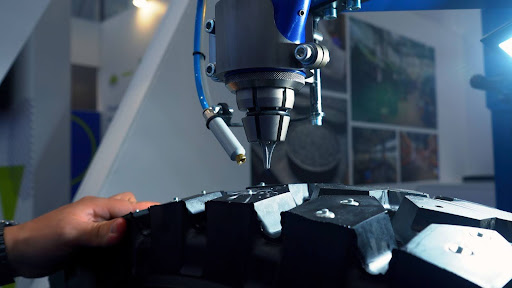
5-axis machining, unlike conventional machining, enables the machine to move in five different axes at the same time. This feature helps to produce complex shapes in a single setup.
The advantages are:
- Reduced Setup Time: Less repositioning means the work goes faster.
- Higher Precision: Better surface finish and closer tolerances.
- Complex Geometry Capability: Suitable for aerospace and electric vehicle drivetrain parts.
- Improved Structural Integrity: Single setup machining reduces the number of alignment mistakes.
- Faster Prototyping: Shorter turnaround product development cycles.
For companies that have very short innovation cycles and very strict regulatory standards, this kind of control can greatly help.
Accelerating Aerospace Innovation
Aerospace engineers need materials like titanium, stainless steel, and high-grade aluminum alloys. These are materials that give strength and durability, but they are also very difficult to machine.
Using 5-axis CNC machining services, manufacturers can efficiently produce:
- Turbine blades with curved profiles
- Lightweight aircraft brackets
- Engine housing components
- Precision aerospace fixtures
- Structural airframe components
Simultaneous multi-axis motion allows for smoother finishes and better dimensional accuracy, thus reducing the need for post-processing. It also helps to meet the demand for fuel-efficient aircraft, where weight reduction leads to greater operational efficiency.
Additionally, aerospace companies are rapidly prototyping and producing small batches to test new ideas. Advanced CNC technology supports the design iteration process by minimizing the need for retooling.
Supporting the EV Revolution
The pace of innovation in electric vehicles is very fast. Manufacturers have to keep on making new versions of their products, whether these are battery management systems or lightweight chassis designs.
Precision CNC machining is critical in:
- Aluminum battery enclosures
- Motor housings
- Cooling system components
- Powertrain parts
- Custom EV prototype parts
EV manufacturing emphasizes the use of lightweight materials such as aluminum and specially formulated alloys. Multi-axis machining enables efficient removal of excess material without weakening the structure of the part.
Another important aspect is scalability. When an EV startup is making a transition from prototype to mass production, the machining processes need to be uniform. With high-precision CNC systems, it is possible to repeat the same quality standards of the product through different lots, even when the volumes increase.
Precision Engineering and Material Expertise
Aerospace and EV manufacturing innovations are driven not only by machines but also by the knowledge of materials. Titanium, aerospace-grade aluminum, and hardened steels require special tooling strategies and process control when being machined.
At Gemsons, we specialize in:
- Precision engineering solutions
- High-accuracy CNC milling and turning
- Complex part machining
- Prototype to production support
- Strict quality inspection standards
Advanced inspection systems verify that each piece meets the requirements of dimensional accuracy and surface finish. In aerospace machining, this compliance is not only crucial but also the traceability part.
Reducing Lead Time Without Compromising Quality
Speed is a factor that counts in industries that are very competitive. Meanwhile, reducing lead time should never mean lowering the level of quality.
5-axis machines can do the work more efficiently by:
- Reducing manual intervention
- Decreasing cumulative tolerance errors
- Making single-fixture machining possible
- Increasing tool life through optimized cutting angles
Reducing production time can be a huge benefit for an EV manufacturer who is about to launch a new model or an aerospace company that is working on next-generation components.
The Role of Rapid Prototyping in Innovation
Rapid prototyping has become a central figure in the world of manufacturing today. Typically, aerospace and EV manufacturers go through many rounds of testing different iterations before they settle on a design.
Advanced CNC machining facilitates the creation of:
- Functional prototypes
- Design validation parts
- Custom tooling
- Small-batch production.
Because 5-axis machines are able to efficiently work with complex geometries, design teams are able to go from CAD design to finished product with little lag time.
Ensuring Structural Performance and Compliance
Safety and compliance are the main issues when it comes to aerospace manufacturing. Besides that, the EV components also have to pass the stringent test of durability and performance.
Precision machining leads to:
- Tight tolerance adherence
- Smooth surface finishes
- Structural consistency
- Accurate hole positioning and alignment
These factors determine the component lifespan, capability to absorb vibrations, and operation efficiency. Making use of lightweight materials for aerospace machining and EV manufacturing has been a trend. Therefore, if advanced machining is used to maintain structural integrity, the result would be the most desirable.
Engineering the Future with Confidence
Both aerospace and electric mobility innovations require not only speed but also high-level accuracy, reliability, and adaptability. Through 5-axis CNC machining services, a company is given the technological support that enables it to manufacture complex, high-performance components that satisfy the ever-changing market needs.
While aerospace manufacturers are probably still engaged in the development of lighter aircraft, EV companies are, simultaneously, working on increasing efficiency and battery life. Alongside this development, advanced multi-axis machining acts as the vehicle that leads these industries in the right direction. What started as a change from CNC milling and manufacturing custom components gradually became aluminum and titanium machining, rapid prototyping, and high-precision engineering solutions. This is a mix of advanced manufacturing technologies that are indeed shaping both industries’ futures.
At Gemsons, we continue to be dedicated to supporting this change with precision-driven solutions to meet complex industrial needs. Through the integration of technical knowledge, advanced CNC machining, and quality control, we assist aerospace and EV innovators in turning their designs into reality.