

Today, several manufacturers rely on precision machining to meet the stringent tolerances, reduce waste, and ensure consistent quality in high-volume production. Two of the most popular methods are CNC turning and CNC milling. Each of them is designed for different part shapes and production goals. By knowing these methods’ differences, a manufacturer can select the one that will produce the best quality, highest efficiency, and the lowest cost, especially when producing CNC milling parts or rotational components.
Understanding CNC Turning
CNC turning is a process in which the workpiece is rotated, and the cutting tool is kept stationary to remove the material. The main feature of this method is that it is very suitable for cylindrical or round components with the same characteristics.
Examples of such parts:
- Shafts, bushings, and pins
- Threaded components
- Sleeves and collars
CNC turning produces outstanding finish quality on circular profiles due to the fact that the part spins very quickly. Besides, it is very effective in making large quantities of identical items; it is extensively used in the automotive, industrial equipment, and fluid handling sectors.
Understanding CNC Milling
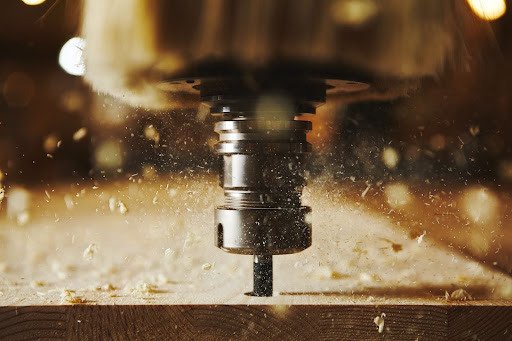
In CNC milling, the cutting tool is the one that rotates while the workpiece stays stationary, which makes it possible for the machine to manufacture complex shapes, flat surfaces, pockets, and intricate contours that are impossible or require a lot of effort with only turning.
CNC milling is mainly employed for:
- Housings and enclosures
- Brackets and fixtures
- Components with slots, cavities, or irregular geometry
If a manufacturer is in the business of producing CNC milling parts, then the procedure opens up the possibility of a greater design freedom and multi-axis capability, thus allowing even tighter tolerances and more complex features with only a single setup.
Process Differences That Matter on the Shop Floor
Although both processes are CNC-controlled and very precise, the differences in their operations have a direct impact on production decisions.
Key distinctions include:
- Part geometry: Turning is more suitable for making round parts, whereas milling is capable of producing complicated and non-cylindrical shapes
- Tool movement: In turning, the tool moves in a straight line; in milling it follows multi-directional paths
- Material removal: In turning, the material is removed quickly from the rotating parts; in milling, the material is removed selectively from the fixed workpieces
These distinctions determine the time needed for a production cycle, tooling expenses, and the production efficiency as a whole.
Precision, Tolerances, and Material Considerations
Both CNC turning and milling are capable of producing precise parts; however, the tolerances are dependent on the design of the part and the type of material used. Aluminiums and other soft metals can be easily machined by both methods, whereas harder alloys may require optimized speeds, feeds, and tooling strategies.
In many cases, manufacturers combine the two processes, turning a piece to get the basic shape and then milling to add the features like keyways, holes, or flats.
When Turning and Milling Work Best Together
In many manufacturing scenarios, CNC turning and CNC milling are not competing processes but complementary ones. A component can first be turned to get the right roundness and concentricity, and then go for milling to add features like flats, slots, cross, holes, or mounting surfaces. This combination method lowers the number of setups, increases dimensional consistency, and decreases the total time of production. If a manufacturer is making complex assemblies or has very tight delivery schedules, using both methods within one production plan typically leads to more accurate parts and results that are more predictable.
A Practical Perspective from the Manufacturing Floor
Gemsons sees the choice between turning and milling as being rarely about which process is better. Instead, it is about using the process that best fits the product’s functional requirements and end-use expectations. Manufacturers can attain consistency in the quality of both CNC milling parts and turned components if they deliberate on the geometry, tolerances, and production volume. The approach of balancing is particularly relevant in the line of managing the growing CNC machining, precision machining, CNC turned components, CNC milling services, and custom machined parts from a variety of industries.