

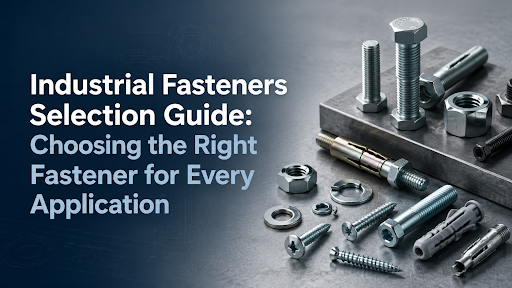
While one might consider fasteners to be minor elements, their significance cannot be underestimated since they play a crucial role in the effectiveness, security, and longevity of machines and various structures. Choosing the right type of fasteners can make a great difference in terms of the effectiveness of the process in industries ranging from building construction to automobile manufacturing or even aviation. Knowledge of the selection of proper industrial fasteners is essential for successful business operations.
Why Fastener Selection Matters
The fastener ensures the effective connection of at least two parts under different operational circumstances. An erroneous choice of the fastener may result in loosening, corrosion, vibrational failures, or even destruction of the connected parts.
In choosing a fastening device, engineers and material procurement specialists need to consider several aspects, such as:
- Load-carrying capacity
- Environmental conditions
- Compatibility with materials
- Method of installation
- Maintenance considerations
- Industry specifications
Every application poses its own set of problems, making it important to select an appropriate fastener.
Understanding Different Types of Fasteners
Fasteners come in many types and are designed according to different uses.
Bolts and Nuts
These fasteners are some of the most common and are very useful due to their great holding power. Bolts and nuts can be easily removed when necessary, thus they are good choices for machinery and other heavy-duty work.
Screws
Screws either create their own threading in the material when being installed or are used with pre-threaded holes. These fasteners are extensively used in industries of all kinds.
Studs and Threaded Rods
Studs are great fasteners for high pressure and high temperatures. They are often used in pipes, valves, industrial equipment, etc.
Rivets
Rivets make a permanent joint and are usually applied in aircraft, transport systems, and also in metal sheet forming.
Anchors
Anchors fasten objects to a concrete or masonry surface and are commonly applied in building and infrastructure constructions.
Understanding Thread Types and Joint Requirements
The use of specific thread designs may have considerable effects on joint security, strength, and ease of assembly. In general, fine threads are more resistant to vibrations and are used in cases when precision is required; however, coarse threads are more easily installed and work better in conditions requiring repeated assembling and disassembling. Another aspect worth considering is the need for creating a permanent connection or one that is easily assembled and disassembled. The consideration of thread design along with the requirements of each particular application case enables the creation of an effective and reliable joint.
Key Factors to Consider Before Selecting a Fastener
Material Selection
The choice of the material for the fastener must be made based on the requirements of the application.
Typical fastener materials are:
- Stainless steel
- Carbon steel
- Alloy steel
- Brass
- Aluminum
- Titanium
- Nickel-based alloys
In case of extreme conditions, like exposure to highly corrosive atmosphere, more specialized materials such as Inconel, Monel, Hastelloy, and other specialty alloys are often preferred because of their higher resistance to harsh conditions. Such materials can be machined by suppliers specialized in the production of such parts.
Corrosion Resistance
Atmospheric conditions affect the performance of fasteners.
Some aspects to consider include:
- Moisture
- Saltwater exposure
- Chemicals
- Extreme temperatures
- Industrial pollutants
Using corrosion-resistant materials and protective coatings can increase life span and limit maintenance costs.
Matching Fasteners to Load Requirements
Each application of a fastener is subject to different forces.
Tensile Loads
The forces tend to pull a fastener apart. High-strength bolts and studs are normally used in applications where high tensile forces are expected.
Shear Loads
The forces are applied perpendicularly to a fastener’s axis. It is essential to choose the right diameter and appropriate material to make a fastener resistant.
Dynamic Loads
Vibration, motion, or variable loads necessitate specific locking devices to ensure that fasteners do not loosen with time.
When there is a need to install fasteners in heavy machinery, pressurized equipment, or crucial structures, choosing appropriate industrial fasteners is of vital importance for the safe and efficient functioning of such applications.
Importance of Industry Standards
Fasteners should comply with recognized standards to ensure quality and interchangeability.
Common standards include:
- ASTM
- ASME
- ISO
- DIN
- ANSI
Such standards establish dimensions, properties of materials, tests to be done, and performance specifications.
Manufacturing through quality-oriented firms with established quality assurance systems based on international standards guarantees uniform production batches. Manufacturers who are capable of producing quality fasteners have good inspection methods to guarantee dependable fastening solutions.
Application-Specific Considerations
Construction Industry
Fasteners for construction purposes should offer excellent resistance to degradation by weather elements and be able to bear heavy loads.
Oil and Gas Industry
Such fasteners should resist corrosive substances and have the capability to perform at elevated temperatures and pressure levels.
Aerospace Sector
Lightweight and precision are paramount since aerospace fasteners employ exotic alloys and need to meet special certifications.
Instrumentation and Process Control
High-precision assemblies demand precise parts that retain their integrity in different operating environments. Special machining knowledge can be very useful in such cases.
The Role of Manufacturing Quality
No matter how good the design, poor manufacturing quality will cause it to fail.
Here are some factors to consider when selecting a fastener manufacturer:
- Capabilities for precision machining
- Ability to track materials
- Systems for quality assurance
- Inspection and testing methods
- Certifications in the industry
- Manufacturing capacity
With modern manufacturing plants and advanced technologies in CNC machining, today’s manufacturing companies are capable of manufacturing extremely precise and accurate industrial fasteners in consistent quality in bulk quantities.
Building Reliability Through the Right Fastening Solution
Finding the right industrial fasteners needs the correct balance between the type of materials that will be used in the fasteners, environmental conditions, loads, industry norms, and manufacturing quality, among other important considerations. Proper selection of a fastener is instrumental in enhancing machine operation efficiency, performance, and safety.
Organizations that require precision-engineered fasteners should consider the services offered by Gemsons, which is an expert manufacturer with years of engineering know-how and highly developed machining skills that provide top-notch industrial products in different industries. From custom fasteners, precision-engineered fasteners, CNC Machining Services, Instrumentation Parts, Oil and Gas Components, Precision CNC Components, to fasteners in exotic materials, Gemsons provides a wide array of services tailored to meet your industrial needs.