
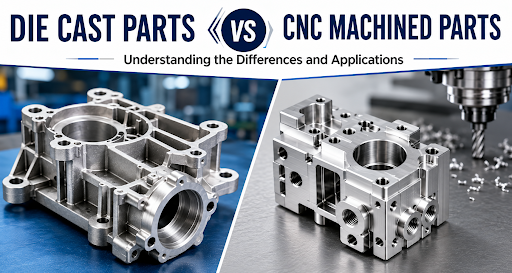
In the modern world, manufacturers utilize different manufacturing processes to manufacture accurate components used in industries such as automotive, electronic appliances, aeronautical industry, medical equipment, and machinery industries. Some of the most commonly used manufacturing processes by manufacturers include die casting and CNC machining. These manufacturing processes are highly accurate for manufacturing metal components but vary greatly in the aspects of production processes, cost-effectiveness, and application.
This information will be helpful for determining which manufacturing process is suitable for your particular manufacturing needs while designing your products and identifying suitable manufacturing processes for these products. The choice of a suitable manufacturing process depends largely on your needs, whether for mass manufacturing or customized parts. It can influence the effectiveness and efficiency of your entire production process. Die-cast parts are one of the most common manufacturing processes.
What Are Die-Cast Components?
Die casting is a manufacturing technique whereby liquid metal is poured into a rigid steel die under pressure. After cooling down, the cast product is removed from the die and undergoes subsequent treatments if needed.
It is most often employed with metals like:
- Aluminum
- Zinc
- Magnesium
- Copper-based alloys
Since the die can be used thousands of times before it needs to be renewed, die casting becomes especially advantageous when high-volume manufacturing is required.
Key Benefits of Die Casting
- Rapid production rate
- Dimensional precision
- Production of intricate parts
- Smooth surface finish
- Low wastage of raw material
- Economical in mass production
The above features make die casting an ideal choice for the manufacture of housings for automobiles, electrical boxes, consumer goods, and industrial equipment.
What Is CNC Machining?
Computer Numerical Control Machining, commonly known as CNC machining, is a subtractive process that involves the removal of material from a metal block by computer-operated cutting machines. CNC machining uses precise instructions stored digitally to manufacture highly accurate parts.
As compared to die casting, CNC machining does not need tooling or molds for each different design, making it suitable for prototype manufacture and custom parts production.
Types of CNC machining include:
- Milling
- Turning
- Drilling
- Grinding
- Threading
There are many materials used in CNC machining, including metals such as aluminum, steel, brass, and titanium, as well as engineering plastics.
Comparing Manufacturing Methods
While both processes are capable of producing good-quality parts, their suitability lies in the nature of the intended use of the processes.
Production Volume
Die casting has been designed for high-volume production. After the creation of the tooling for manufacturing, thousands, if not millions, of identical pieces could be produced.
However, CNC machining works better in cases of:
- Prototype development
- Limited quantities of production
- Custom design manufacture
- Design validation stages
Design Complexity
Die casting allows companies to fabricate parts with complicated designs, thin walls, internal spaces, and other complexities in one process.
As CNC machining can make complicated shapes, certain designs would need more than one machining operation, adding to the cost of production.
Accuracy and Tolerances
The CNC process usually provides very accurate tolerances, with high precision, which makes it ideal for processes that require highly accurate measurements.
But now, due to advancements in modern manufacturing techniques, die-cast parts can be made to achieve the required level of dimensional accuracy.
Tooling Requirements
This is another main difference between the two processes: The tooling required.
In die casting:
- Design of mold
- Tool manufacturing
- Initial tooling costs
In CNC machining:
- Programming in CAD
- Setting up the machine
- Use of cutting tools
With CNC machining, there is an added flexibility in case designs keep changing since the process doesn’t require molds.
Cost Considerations
In many cases, cost becomes an important factor in determining which method of manufacturing is to be used.
Die Casting Costs
While the tooling cost may be high, it becomes more affordable per part after the mold is made.
The reasons why die casting remains very cost-effective for:
- Automobile manufacturing
- Electronic devices
- Home appliances
- Heavy machinery
CNC Machining Costs
Since there is no need to make molds during CNC machining, it has lower setup costs. However, each piece that is made requires machine time and therefore increases the per-unit cost for mass production.
For businesses producing limited quantities, CNC machining may provide a more practical and cost-effective solution.
Applications Across Industries
There are various industries in which die casting and CNC machining are applied in different applications.
Common Die Casting Applications
- Automotive transmission housings
- Engine components
- Lighting fixtures
- Power tool housings
- Electrical enclosures
- Telecommunications equipment
Common CNC Machining Applications
- Aerospace components
- Medical instruments
- Robotics parts
- Industrial prototypes
- Precision mechanical assemblies
- Specialized engineering equipment
However, it all depends on the size of production, level of performance, and objectives of the design.
Factors to Consider Before Choosing
Before adopting either method of manufacture, businesses should consider a few aspects, including:
Consider Die Casting When:
- High volumes of production are required
- Quality must be consistent
- Complex shapes are needed
- Desired lower unit cost
Consider CNC Machining When:
- Volume of production is low
- There is an expected change in designs
- Tighter tolerances are required
- Need for rapid prototyping
Both processes are adopted by many organizations at various stages of manufacturing products. For instance, CNC machining is usually applied in prototype creation before adopting die casting for full-scale production.
Manufacturing Decisions That Support Long-Term Performance
The choice between die casting and CNC machining cannot be based solely on the price factor. There is always a question of production volumes, the level of precision required, deadlines, and the strategy for future manufacture. As the industry requires lightweight, yet strong and complex parts, these two manufacturing methods will continue to play a crucial role in the process.
In terms of making choices for production, having a grasp of the advantages of die cast parts, along with knowledge of skills like aluminum die casting, precision machining, custom metal parts, zinc die casting, industrial castings, and high-pressure die casting, could be beneficial to those who are assessing their engineering and purchasing needs. Companies like Gemsons, which specializes in producing highly engineered metal parts, show how the field is progressing towards fulfilling higher demands.