

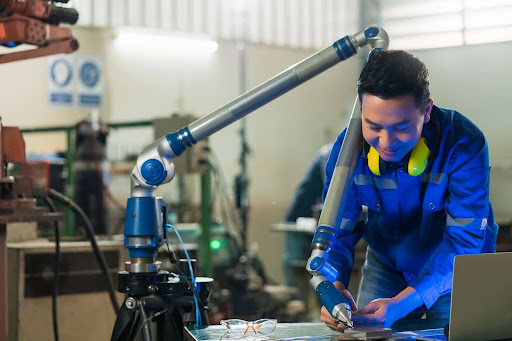
Automation and robotics have moved far beyond being just experimental technology. These technologies are now inevitable in operations such as manufacturing, logistics, and healthcare, amongst many other rapidly developing sectors. At the very heart of this transformation is precision manufacturing, most notably CNC machining, which makes it possible to create complicated, tough, and highly consistent parts. Parts for industrial automation parts like robotic arms and automated assembly lines, must be produced with micron-level accuracy, consistent quality, and material properties that can withstand a continuous operation environment.
Precision CNC machining is key to meeting such requirements. It is the link between design intent and real-world performance, facilitating automated equipment to run not only effectively, but also in a safe and environmentally friendly way.
Why Precision Matters in Automated Systems
Automation systems nowadays are very complex and highly integrated. A slight error in the size of a single part can cause changes to the system’s overall performance, such as alignment, speed, load handling, or safety. CNC precision machining makes sure every part is made exactly to the design specifications, hence limiting the system errors and breakdowns.
In the case of robotics, precision goes beyond being a mere feature. It is a fundamental requirement. Robotic joints, linear motion assemblies, and end effectors are all dependent on precise tolerances to perform repeatable movements. CNC machining can produce these parts with the same degree of accuracy, even when made in different batches. This aspect becomes crucial in scalable automation projects.
CNC Machining as the Backbone of Robotics Manufacturing
Each component of a robotic system has its own function, and they are all interconnected to form the whole. CNC machining complements this kind of complexity by providing the following capabilities:
- Very precise dimensions that result in smooth movement and low friction
- Excellent repeatability to produce a large volume of identical parts
- Complex shapes that cannot be done by traditional cutting methods
Components like gear housings, actuator mounts, frames, and precision brackets are among the main beneficiaries of CNC processes. Using advanced multi-axis machining, more complex geometries can be achieved in fewer setups, leading to higher accuracy and shorter lead times.
Supporting Performance Under Continuous Operation
Automated systems, unlike traditional ones, often run 24 hours a day, 7 days a week. Parts have to endure continuous movement, vibration, and load cycles without changing shape or breaking. Precision CNC machining is the key to achieving this by ensuring dimensional stability and maintaining surface finish consistency.
High-quality machining also enhances:
- Load-bearing capability
- Thermal stability during long operating hours
- Reduced wear in moving assemblies
If parts are made with high precision for the first time, they will need minimal adjustment during assembly and will be dependable for a longer period.
Materials and Machining Go Hand in Hand
Automation and robotics depend heavily on materials such as aluminum, stainless steel, engineering plastics, and special alloys. CNC machining makes it possible to treat each material with the proper cutting conditions to achieve maximum strength and finish.
Material choice, along with precise machining, is what allows manufacturers to balance weight, strength, and durability. Thus, lightweight aluminum parts enhance robot speed and lower energy consumption, while, on the other hand, hardened steel ones are great for heavy-load or high-impact situations.
Such versatility in the choice of materials is one of the reasons why CNC machining is still a necessity in the present-day industrial automation manufacturing world.
Improving Assembly Efficiency and System Reliability
Precision, machined components greatly facilitate the assembly of the system. Where the various components are made according to the exact specifications, they fit each other perfectly, thus greatly reducing the need for adjustment or even fixing of the parts on the shop floor.
Main advantages are:
- Faster assembly times
- Lower rejection and rework rates
- Improved overall system reliability
For robotics integrators and automation engineers, this means that they will have performance that they can predict and maintenance that is very simple.
Precision That Empowers Progress
The automation and robotics industry depends on components that are precise, reliable, and sturdy. Precision CNC machining achieves this by making the parts behave consistently regardless of the designs, materials, and production volumes. Whether it’s the early-stage prototypes or the full-scale deployment, CNC machining is a major factor in innovations in automation.
With the rising complexity of systems, there will be an increasing need for industrial automation parts that comply with the highest standards. Gemsons is the best choice for this type of applications, which require utmost reliability, due to its thorough knowledge of precision manufacturing and the production of automation, specific components.
In this changing environment, precision goes beyond just being a manufacturing necessity; it is what makes it possible for automation to be at its peak performance, backed by the capabilities of precision CNC machining services, robotic components manufacturing, custom machined parts, high-tolerance metal components, and advanced manufacturing solutions that continue to define the future of intelligent automation.