

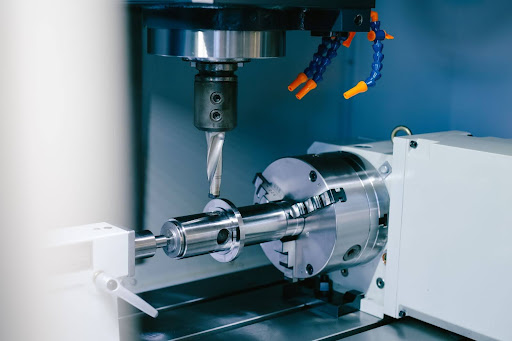
Aerospace manufacturing necessitates precision, durability, and efficiency at every stage. Aerospace CNC machining is one of the processes that plays a critical role in producing highly accurate parts for aircraft, spacecraft, and defense applications. However, dealing with intricate materials, tight tolerances, and high-quality standards is quite challenging for the manufacturers. Those in the aerospace industry need to be familiar with such challenges and see how the experts solve them.
Material Complexity and Machining Challenges
Advanced materials are one of the major issues of aerospace CNC machining. The parts are sometimes made of titanium, inconel, or high-strength aluminum alloys, which all have their own difficulties in being machined:
- Titanium: Although it is light in weight and strong, the thermal conductivity of titanium is low, which may lead to heat accumulation and damage to the working tool.
- Inconel: It is very resistant to high temperatures. This property, therefore, results in wearing out the cutting tools and slowing down the machining speeds.
- High-strength aluminum alloys: These materials are easier to machine than the other two, but softening is still necessary to be taken in terms of handling to prevent warping or surface flaws.
Such materials call for very fine adjustment of the cutting speeds, feed rates, and cooling methods. Usually, highly skilled professionals use advanced CNC machines provided with real-time monitoring systems to maintain quality.
Tight Tolerances and Precision Requirements
Parts of airplanes have to be extremely precise, mostly within microns. A slight change in the value may cause the performance or safety of the airplane to be compromised. Although there are many obstacles to be overcome in achieving such high precision, here are only a few of them:
- Tool deflection and vibration may lead to errors in dimensions.
- Thermal expansion of the part during the machining process can lead to its inaccuracy.
- Complex shapes increase the chances of inaccuracies if the programming is not done carefully.
Engineers are increasingly relying on multi-axis CNC machines, precision fixturing, and advanced simulation software to address the issues. These tools make it possible to plan the process and carry it out so accurately, thus reducing the number of errors and ensuring that parts meet the strict industry standards.
Quality Compliance and Aerospace Certifications
Besides precision and the understanding of the material, aerospace manufacturing is also characterized by very strict regulatory and quality standards. Each part has to comply with internationally recognized aerospace certifications and traceability standards. Such a procedure requires very detailed documentation, process validation, and thorough inspection at every stage of machining. It is challenging to maintain consistency while meeting such standards, especially when manufacturing complex and safety-critical parts.
However, experts are able to solve the issue with the use of in-process inspection, advanced metrology tools, and quality management systems, which are not only standardized but also comply with aerospace regulations. By implementing these methods, a company can be sure that it is achieving not only the dimensional accuracy of the parts but also the repeatability, the accountability, and the long-term reliability of the whole production batch.
Managing Surface Finish and Structural Integrity
Aerospace components must have an excellent surface finish, particularly if they are parts that will be subjected to high stress or aerodynamic forces. A bad surface finish can result in fatigue, corrosion, or other types of structural failure. Some of the reasons for which achieving the required finish can be difficult include:
- Material hardness makes it difficult to cut smoothly.
- Small features and complex shapes.
- High-speed machining, which might lead to chatter marks or surface defects.
By using special tooling, methods for coating, and post-machining operations such as polishing or stress-relief treatments, the professionals ensure that the surface quality is not only excellent but also that the parts have the required strength.
Optimizing Production Efficiency
Apart from that, the issue of balancing between speed and quality also stands out as a major problem. It is usual for aerospace CNC machining to have long production cycles that consist of multiple steps, such as roughing, semi-finishing, and finishing. Any lateness or mistake at one stage will have an impact on the delivery schedule and will increase the costs.
- Proper tool path planning can save a lot of time.
- Automated monitoring systems that track tool wear make it possible to avoid downtime.
- Lean manufacturing principles help make the processes simpler and more efficient.
They have achieved the optimal level of efficiency by continually renewing their tools and software and introducing automation and predictive maintenance into their methods.
Skilled Workforce and Technical Expertise
Operators and engineers who are well-trained and highly experienced are the ones that:
- Accurately program CNC machines.
- Select the correct tools and machining strategies.
- Perform inspections and quality verification of components throughout production.
In order to produce high-quality work and keep the number of errors at a minimum, most of the time, workers are sent to training sessions, and they must be familiar with the latest aerospace standards.
Innovative Approaches and Emerging Solutions
Various aerospace CNC machining personnel are increasingly implementing:
- High-performance cutting tools: Coated or composite tools made for specific materials.
- Advanced simulation software: This software can identify the problems that might occur and will also set the best tool paths before production.
- Automation and robotics: Minimizes human error and improves repeatability.
- Additive manufacturing hybrid approaches: Utilize the strengths of both CNC machining and 3D printing for the production of complex shapes and less material wastage.
Such achievements allow the manufacturers not only to comply with the stringent aerospace standards but also to increase production efficiency and decrease costs.
Ensuring Reliability in Every Component
In the aerospace industry, reliability is non-negotiable. Each component must perform flawlessly under extreme conditions, and aerospace CNC machining plays a pivotal role in delivering this reliability. By choosing the right material, machining accurately, and going for the latest technology, professionals make sure the parts are up to the very high standards of the industry.
If you are a company that needs reliable solutions, then you should check out Gemsons, a company that is recognized as one of the leaders in this industry. They can equip you with the knowledge and technology to overcome the challenges of aerospace manufacturing by their comprehensive range of CNC machining services, such as multi-axis machining, precision milling, or component inspection. Moreover, with the combination of their commitment to quality and innovation, Gemsons will be a dependable partner for you in the manufacturing of high-performance aerospace components.